[email protected]

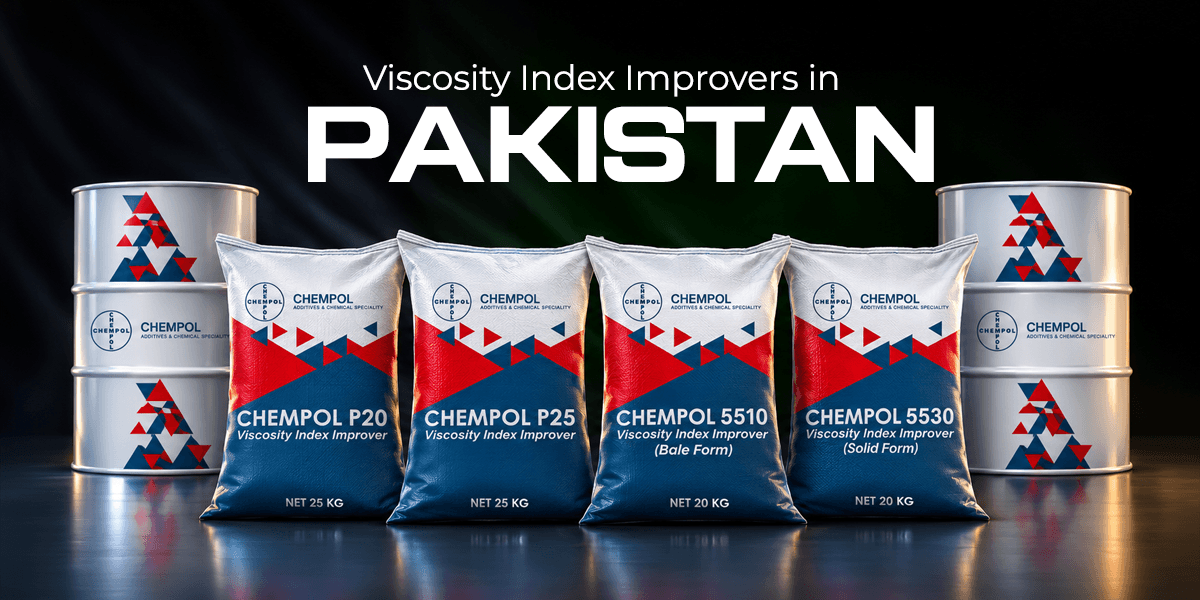
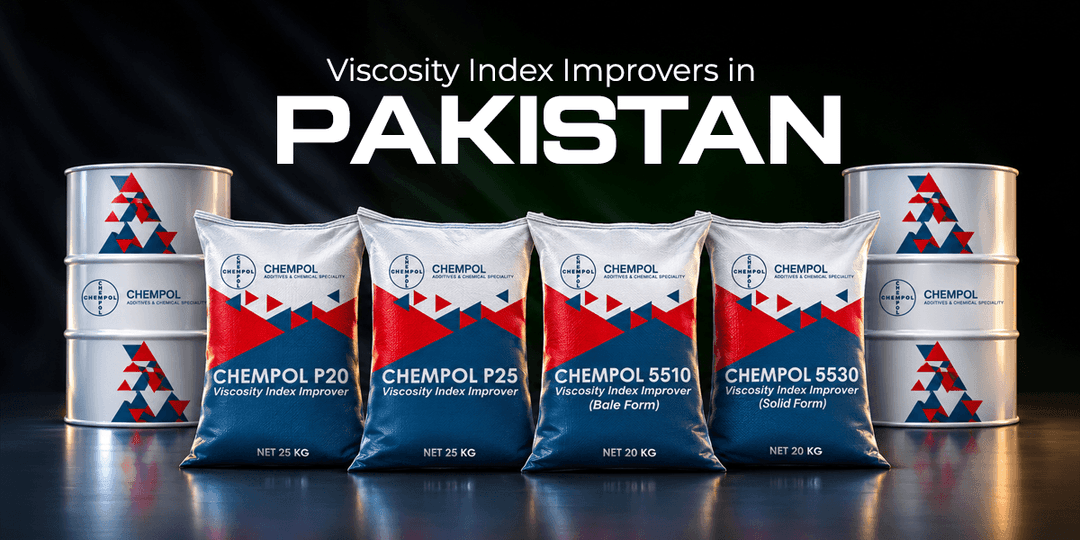
Viscosity Index Improvers in Pakistan
Viscosity Index Improvers in Pakistan plays an important role in helping lubricant manufacturers formulate oils that maintain suitable viscosity across changing operating temperatures. They are used in multigrade engine oils and special industrial lubricants, and are essential for reducing the rate of thinning of polymer-based lubricants as temperatures increase.
Choosing the right VI improver is a critical decision for lubricant manufacturers and formulators in Pakistan, considering factors such as polymer chemistry, thickening efficiency, shear stability, base oil compatibility, and operating conditions. Selecting the appropriate additive can meet the lubricant’s desired properties and ensure consistency in the formulation.
Chempol offers a variety of viscosity index improvers that use polymers to achieve viscosities suitable for various lubricant applications. Discover Chempol’s viscosity index improver portfolio to find the right solutions for your manufacturing needs.
What Are Viscosity Index Improvers and Why Are They Used in Lubricants?
Viscosity Index Improvers (VI improvers) are polymer-based lubricant additives that control changes in oil viscosity with temperature. It is a fact that lubricants become thinner in hot conditions and thicker in cold conditions, and it’s crucial to maintain the correct viscosity across various operating conditions to ensure effective lubrication.
The viscosity index (VI) measures how viscosity varies with temperature. The higher the VI, the smaller the change in viscosity with increasing temperature.
An oil viscosity index improver helps manufacturers create multigrade lubricants that maintain proper viscosity at both cold and high operating temperatures. These additives are particularly important in automotive engine oils, industrial lubricants, and other formulations that experience changing operating temperatures.
Viscosity improver additives are valuable to a lubricant formulator since they allow the formulation of the required viscosity properties in addition to those of the base oil.
How Do Polymer-Based Viscosity Index Improvers Work?
The principle of operation of polymer viscosity index improvers is based on the polymer’s temperature-dependent behaviour in the lubricant. They can affect oil viscosity at both low and high temperatures due to their molecular structure.
As the temperature rises, the base oil gets thinner. The effective hydrodynamic volume of polymer chains increases due to thermal expansion, thereby contributing to the lubricant’s viscosity. This will offset some of the loss of viscosity caused by heating the oil.
The polymers reduce thickening at lower temperatures, which is important to ensure the formulation has appropriate low-temperature flow properties.
Mechanical stress, however, also influences the performance of polymers. High shear forces can temporarily or permanently influence a polymer’s structure in engines, gears, and hydraulic systems. This is why the thickening efficiency of a viscosity modifier should be assessed alongside its shear stability when choosing one for engine oil.
Why Are Viscosity Index Improvers Important in Pakistan’s Climate?
There is a significant seasonal and regional variation in temperature in Pakistan. There are different requirements for automotive and industrial lubricants due to extremely hot summers in the plains and cooler weather in the northern regions.
Engine oils need to have the right viscosity when the engine is cold and starting up, as well as at normal operating temperatures. In the same way, industrial lubricants can be subjected to continuous operation and high temperatures, and mechanical stress.
For the lubricant manufacturers in Pakistan, choosing the appropriate viscosity index improver can overcome these formulation challenges. The proper polymer for multigrade oil can help maintain viscosity under different operating conditions.
The selection should take into account the use, base oil type, desired and expected mechanical shear, and viscosity grade. These factors aid manufacturers in developing formulations appropriate for the area’s operating conditions.
Types of Polymer-Based Viscosity Index Improvers for Lubricant Manufacturing
Various polymer chemistries exhibit different viscosity-modification properties. Knowing these differences can assist manufacturers in choosing the appropriate lubricant polymer additives for automotive and industrial applications.
Olefin Copolymer (OCP) Viscosity Index Improvers
Olefin Copolymer (OCP) viscosity index improvers are commonly used in automotive engine oils and industrial lubricants. They are used to modify viscosity and control changes in viscosity with increasing temperature due to the polymer structure.
Their effectiveness depends on molecular weight, polymer structure, concentration, and compatibility with the chosen base oil. OCP-based additives are normally included in multigrade engine oil formulations where thickening efficiency and shear stability are important.
Chempol offers a range of OCP-derived viscosity modifiers for various lubricant applications, including CHEMPOL 5530 and CHEMPOL 5550.
Ethylene Propylene Copolymer VI Improvers
Ethylene Propylene Copolymer is a polymer chemistry used in the wider family of OCPs. Depending on the molecular structure and physical form, these polymers can be used in various automotive and industrial lubricants.
They may have different performance depending on molecular weight distribution, concentration, and formulation requirements. They come in various forms, such as pellets, bales, and liquid concentrates, which manufacturers can choose based on their blending processes.
Polymethacrylate (PMA) Viscosity Index Improvers
Another approach to controlling the viscosity of a lubricant over a wide temperature range is to use a viscosity index improver, such as polymethacrylate (PMA). The properties of these depend on the polymer composition and the molecular weight and structure.
PMA-based additives may be considered for specialist lubricant formulations where viscosity modification, low-temperature properties, and shear stability are major considerations in additive selection.
CHEMPOL 5403 is one of Chempol’s liquid viscosity index improvers based on PMA and is offered for selected applications in hydraulic, transmission, gear, UTTO wet-brake, and shock-absorber oils.
Benefits of Using Shear Stable Viscosity Index Improvers
The shear-stable viscosity index improvers assist the lubricant manufacturer in maintaining the lubricant's viscosity characteristics. This is particularly important in automotive and industrial applications where lubricants experience continuous movement, pressure, and mechanical forces.
They have several advantages, including better retention of viscosity. A proper polymer will ensure that the lubricant retains its desired viscosity characteristics during operation, helping establish the correct lubricating film.
Another important aspect is shear stability. When polymer chains experience mechanical stress, permanent changes in molecular structure can reduce their contribution to thickening. By choosing a low SSI viscosity index improver, the permanent viscosity loss under specified test conditions can be reduced.
These additives also help formulate multigrade lubricants that balance high-temperature viscosity requirements with appropriate low-temperature performance. Additionally, viscosity modifiers can affect potential fuel efficiency benefits by enabling the selection of an appropriate lubricant viscosity in the complete formulation.
But full performance is achieved only if the complete additive package, base oil, engine design, and operating conditions are all correct. Manufacturers should evaluate the properties of finished lubricants rather than relying on polymer characteristics alone.
Applications of Viscosity Index Improvers in Automotive and Industrial Lubricants
Viscosity Index Improvers are applied in a variety of lubricant types where it is essential to maintain viscosity over the lubricant’s temperature range.
Viscosity Index Improvers for Automotive Engine Oils
VI improvers are used in a wide variety of applications, including automotive engine oils. Multigrade oil products should have the right viscosity for the engine’s cold-start conditions and high-temperature operating conditions. The use of polymer additives is beneficial for the manufacturer in meeting the desired viscosity grade and formulation performance.
Viscosity Index Improvers for Industrial Lubricants
Continuous mechanical loading and changing temperatures are typical conditions in which industrial lubricants are required to function. A viscosity index improver for industrial lubricants can enable manufacturers to produce fluids with the appropriate viscosity for specific equipment and applications.
Viscosity Index Improvers for Hydraulic and Gear Oils
Hydraulic oils must have the proper viscosity to ensure the system functions across a range of temperatures. There are VI improvers available that can be selected to provide the desired viscosity response with suitable shear stability.
Likewise, some automotive gear oils and transmission fluids contain polymer-based viscosity modifiers to impart the desired viscosity properties. The mechanical stresses and specifications of each application need to be taken into account when selecting products.
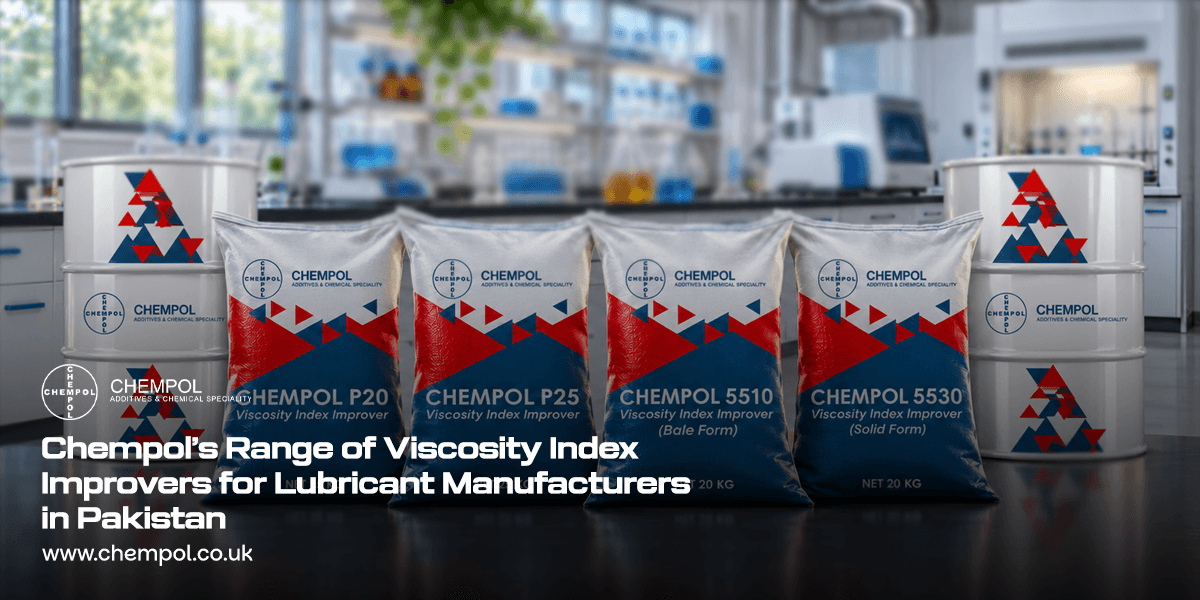
Chempol’s Range of Viscosity Index Improvers for Lubricant Manufacturers in Pakistan
Chempol offers a range of polymer-based viscosity index improvers in various polymer chemistries and physical forms for automotive and industrial lubricant formulations. Our product range includes solid, pellet, bale and concentrated liquid options.
These products offer lubricant manufacturers different choices based on their required thickening efficiency, shear stability, blending processes and finished lubricant specifications.
CHEMPOL 5530
CHEMPOL 5530 is a solid-form OCP viscosity index improver for monograde and multigrade crankcase oils, as well as industrial lubricants. Chempol claims to offer a balanced combination of thickening efficiency & medium shear stability, low-temperature performance, and rapid base oil dissolution.
Chempol 5550
CHEMPOL 5550 is a shear-stable viscosity index improver in bale form, based on OCP chemistry. For monograde and multigrade crankcase oils and industrial lubes, product features include thickening efficiency, shear stability, and low-temperature performance.
Chempol 5510
CHEMPOL 5510 is an ethylene-propylene copolymer in amorphous, transparent bale, for use in multigrade engine oils and industrial lubricants. According to Chempol, the SSI range for a product is 18-22, and appropriate pour-point depressants can improve low-temperature fluidity.
CHEMPOL P20 and CHEMPOL P25 Pellet-Based Viscosity Improvers
CHEMPOL P20 is a pellet form of linear ethylene-propylene copolymer. It can be used for monograde and multigrade crankcase oils and industrial lubricants. It has moderate shear stability in suitable base oils and can be used to modify viscosity in various lubricant formulations.
CHEMPOL P25 is an ethylene-propylene copolymer in pellet form with a narrow molecular weight distribution. Chempol emphasizes high thickening ability and low-temperature characteristics in mineral-oil-based automobile crankcase and industrial lubricants.
VISCOMAX and VISCOPOLY 1000 Concentrated Liquid VI Improvers
VISCOMAX is a high-concentration liquid, solubilized ethylene-propylene copolymer. Multigrade Gasoline & Diesel Engine Oils. Chempol boasts easy handling and mixing and offers 1300, 1800, and 2200 grades, with a published SSI of 24.
VISCOPOLY 1000 is a concentrated liquid OCP solution in a Group III base oil. Meant for multigrade gasoline and diesel engine oils. According to its product information, it exhibits the following characteristics: low-temperature properties and low volatility; the published SSI range is 22-24.
CHEMPOL 5026 and CHEMPOL 5403 Liquid Viscosity Index Improvers
CHEMPOL 5026 is a low-SSI liquid amorphous ethylene-propylene copolymer in multigrade crankcase oils and industrial lubricants. It is based on a hydrotreated or hydrocracked carrier fluid. Chempol specifies an SSI range of 18-22 and recommends a suitable pour point depressant for low temperature applications.
CHEMPOL 5403 is a liquid viscosity index improver based on PMA for use where high VI improvement and low SSI are required. It is used in automotive transmission oils, multigrade premium gear oils, UTTO wet-brake oils, shock-absorber oils, and low-SSI hydraulic oils. Chempol reports an SSI range of 15–20.
Contact Chempol’s technical and sales team for detailed product specifications, Technical Data Sheets (TDS), and help with comparing polymer grades to suit your requirements.
How to Select the Right Viscosity Index Improver for Your Lubricant Formulation
To choose the proper viscosity index improver, it is necessary to be familiar with the technical requirements of the final lubricant. Different polymer chemistries and product forms provide different characteristics, making product selection an important part of lubricant formulation.
Consider the Required Viscosity Grade and Polymer Chemistry
The initial one is the desired viscosity grade of the finished lubricant. Manufacturers should consider the polymer’s contribution to viscosity and compare the OCP, ethylene-propylene copolymer, and PMA options based on the application.
Evaluate Shear Stability Index and Base Oil Compatibility
When choosing a polymer viscosity index improver, one of the key factors to consider is shear stability index. Lower SSI values typically indicate less permanent loss of viscosity under mechanical shear. However, manufacturers should compare SSI values obtained using the same test methods and relative to the application conditions.
Compatibility with the base oil is also crucial. The polymer should dissolve or be properly incorporated in the base stock used and be effective in the full range of additives.
Match Operating Temperature and Lubricant Application
Operating temperature influences the viscosity requirements of automotive and industrial lubricants. When choosing an additive, the manufacturer should consider cold-start performance, high-temperature viscosity, mechanical stress, and equipment application.
Consider Product Form and Blending Requirements
VI improvers can be in solid, pellet, bale, or liquid form. Blending equipment, handling procedures, storage, and manufacturing processes should be considered. While liquid concentrates may offer convenience, solid and pellet forms may be appropriate for specific production needs.
These factors should be discussed with Chempol’s technical team, which can help lubricant manufacturers select suitable products for their formulations. Share your target viscosity grade, base oil, and intended application to request a product recommendation and quotation.
Why Choose Chempol for Viscosity Index Improvers in Pakistan?
Just price is not the only criterion to consider when finding a reliable viscosity index improver supplier in Pakistan. Lubricant manufacturers must have access to appropriate polymer technologies, technically sound information, and products that satisfy their formulation needs.
Chempol’s viscosity index improvers include a variety of OCP, ethylene-propylene copolymer, and PMA types. It covers various physical shapes and product specifications for automotive engine oils, industrial lubricants, and special lubricant applications.
If a manufacturer is interested in a viscosity index improver manufacturer in Pakistan, then Chempol will provide product information and technical assistance to facilitate the selection process. It offers a product range that enables formulators to compare polymer options for thickening effectiveness, SSI properties, base oil compatibility, and blending requirements.
For Pakistani customers, Chempol also mentions a Lahore office where they can inquire about the product and discuss their commercial needs.
Contact Chempol for Viscosity Index Improvers in Pakistan
The selection of the appropriate polymer viscosity index improver can significantly impact lubricant formulation and manufacturing productivity. Faultless polymer choice is critical when you’re formulating multigrade engine oils, industrial lubricants, hydraulic oils, or specialist lubricant products, and considerations such as viscosity, shear stability, and base oil compatibility are all important.
Chempol provides various viscosity index improver solutions to help lubricant manufacturers and formulators. Contact the team to discuss your formulation needs, request Technical Data Sheets, view products, or obtain a commercial quote.