No products found
[email protected]

PAO vs Ester Base Oil: Properties, Performance and Uses
Selecting the right synthetic base oil for a lubricant is a critical decision for lubricant manufacturers, oil blenders, and industrial formulators. The choice of base oil directly affects the lubricant’s performance, oxidation resistance, thermal stability, viscosity characteristics, and compatibility with additives and equipment.
The two most popular types of synthetic base oil are Polyalphaolefins (PAOs) and synthetic esters. Both have advantages over many traditional mineral-based oils, and there are significant differences in their chemical structures and properties.
When it comes to producing automotive lubricants, industrial gear oils, compressor fluids, hydraulic systems, and specialty applications, knowing the difference between PAO vs. Ester base oil can help lubricant manufacturers choose the right raw material for their lubricant.
In this blog, we will explore the pros, cons, and uses of both synthetic base oils to help formulators and procurement teams make informed choices when purchasing an oil.
PAO vs Ester Base Oil: Chemistry and Classification
Polyalphaolefins and synthetic esters are chemically engineered base oils designed to provide controlled lubricant properties. Both are in the same general class of synthetic lubricants, but their molecular structures lead to differences in polarity, additive solubility, oxidation behavior, and metal-surface interactions.
PAOs are synthetic hydrocarbons manufactured by polymerizing alpha-olefins. According to the API base oil classification system, they fall under Group IV. They have a relatively uniform molecular structure, which allows for predictable viscosity, excellent oxidation resistance, and favorable low-temperature properties.
Synthetic esters are made by chemically reacting acids with alcohols. They are part of Group V, which comprises several base stocks not categorized into groups I-IV.
Examples of common esters are diesters, polyol esters, and complex esters. Each type has unique viscosity and polarity, thermal stability, and compatibility properties.
Knowing about these Group IV and Group V Base Oils is critical, as neither is necessarily a better performer. The quality of the finished lubricant will depend on the base oil grade used, the additive package, application requirements, and operating conditions.
Polyalphaolefin Oil Properties and PAO Synthetic Lubricant Benefits
The oxidation stability, good viscosity-temperature properties, and low-temperature fluidity make PAOs popular in high-performance lubricants.
These Polyalphaolefin Base Stock Properties make PAOs appealing to lubricant formulators seeking to design products for use in challenging industrial or automotive applications.
PAO Oxidation Stability and Thermal Performance
Among the important benefits of PAO synthetic lubricants is their oxidation stability. PAOs have a saturated hydrocarbon structure and offer fair to good resistance to oxidative degradation compared with conventional mineral base oils.
In long-term lubricant use, exposure to oxygen and higher temperatures may help to cause viscosity changes, acid formation, and deposits. Oxidation-resistant base oils enable formulators to meet these challenges.
But the antioxidant additives, operating temperatures, contamination, and service conditions are also factors in the finished lubricant’s oxidation performance.
PAOs are also under consideration for use at high temperatures, but thermal breakdown resistance and oxidation resistance may need to be tested separately.
PAO Base Oil Volatility and Low-Temperature Viscosity
Lubricants used under constant heat must account for PAO Base Oil Volatility. Depending on the viscosity and molecular composition, suitable PAO grades will offer relatively low evaporation losses.
Another important attribute is good low-temperature viscosity. PAOs have low pour points, which improve the flow and circulation of lubricants in cold conditions.
They also have a high VI, which means they will have more stable VI performance across varying temperatures.
These properties make PAOs excellent candidates for synthetic engine oils, gear lubricants, and industrial fluids that must operate over a wide temperature range without failure.
However, some additives may be less soluble in PAOs due to their relatively lower polarity, and the choice of co-base stock may be critical for formulation development.
Ester Base Oil Properties and High-Temperature Lubricant Performance
Synthetic esters are a different blend of characteristics, partly due to the presence of polar ester groups in their molecular structure.
This polarity affects the lubricant’s solvency, its interactions with metal surfaces, and its compatibility with other components of the lubricant formulation.
Ester Oil Metal Wetting Properties and Additive Solubility
A benefit of synthetic esters is that they can interact with metal surfaces through polar functional groups.
These Ester Oil Metal Wetting Properties can aid surface coverage and lubricant film formation. But metal wetting is not the benchmark of anti-wear performance; it needs to be determined within the finished formulation.
Esters can also be used to help dissolve some additives in the lubricant that are not soluble in non-polar PAOs.
This property makes certain esters useful in mixed synthetic lubricants when the formulator must consider which base oils and additives will be compatible.
Additionally, their solvency properties can affect deposit management depending on the ester chemistry and the entire lubricant formulation.
Ester vs PAO Oxidation Stability and Thermal Behaviour
For manufacturers developing lubricants for high-temperature applications, Ester vs. PAO Oxidation Stability is a typical consideration.
The saturated hydrocarbon structure of PAOs provides good oxidation resistance. Some synthetic esters can also be highly stable to oxidation and high temperatures, especially when compounded with appropriate antioxidants.
Molecular structure strongly influences the Thermal Stability of Ester Oils. Therefore, it is not possible to assume that one grade of ester will perform the same as another.
When choosing a Synthetic Base Oil for High Temperature applications, manufacturers should evaluate all the properties of the oil such as oxidation resistance, volatility, viscosity, and material compatibility.
Some ester formulations are also susceptible to hydrolysis due to moisture and high temperatures.
Thus, it is necessary to conduct application-specific testing to determine whether an ester base stock is suitable for equipment operating under demanding conditions.
PAO and Ester Lubricant Compatibility in Synthetic Formulations
Compatibility between PAO and ester lubricants is important when developing blended synthetic lubricants.
PAOs are mostly non-polar, and esters are polar, so blending the two has been shown to give formulators the properties they may not obtain from either base oil alone.
For instance, an appropriate ester portion can be used to optimize the solubility of additives in the PAO base lubricant formulation while maintaining desirable low-temperature and viscosity properties.
But compatibility doesn’t stop at a combination of two base oils.
Lubricant Base Oil Compatibility also relates to elastomer seals, coatings, additive packages, and any lubricant already in the equipment.
Various base oils can cause varying amounts of seal swell or contraction. Water sensitivity and interactions with some materials may also be influenced by ester chemistry.
Therefore, manufacturers should not just consider the chemical group of the base stocks in the formulation.
Laboratory compatibility testing, storage stability evaluation, and application-relevant performance testing indicate if a PAO–ester blend complies with the planned specifications.
The best option would be a formulation that provides the desired Synthetic Base Oil Performance, can be used in the equipment without loss of additive efficacy, and has long-term stability.
Ester Base Oil Applications and PAO Selection for Industrial Lubricants
There are various categories of lubricants where Ester Base Oil Applications and PAO applications overlap. When choosing between them, operating temperature, viscosity requirements, equipment design, and the lubricant’s performance goals must be considered.
Synthetic Base Oils for Gear Oils and Compressor Lubricants
Synthetic Base Oils for Gear Oils should provide proper viscosity, load-carrying capacity, oxidation stability, and additive compatibility.
PAOs are often considered when wide-temperature operation and oxidative resistance are important. Esters can be chosen or combined in formulations to impart extra value in terms of polarity, additive solvency, or thermal properties.
Due to the diversity of compressor designs, operating temperatures, and compressed gases, careful evaluation of Base Oils for Compressor Lubricants is required.
For some compressor applications, either PAOs or selected ester grades can be used. However, the evaluation of the volatility, oxidation resistance, deposit formation, and compatibility with equipment materials must be done individually.
PAO and Ester Base Oils for Engine Oils and Hydraulic Fluids
PAOs provide beneficial viscosity-temperature properties and oxidation stability in automotive engine oils. Appropriate esters can be used in combination with PAOs to enhance additive solubility in the formulation and other properties.
Finished engine oils must comply with current industry and equipment manufacturer standards.
Other hydraulic fluid properties that are considered when selecting synthetic base oils include viscosity control, oxidation resistance, seal compatibility, and pumpability.
PAOs may be considered for hydraulic systems in cold environments, and ester-based fluids may be considered if special performance or solvency requirements are needed.
Synthetic Base Oils for Grease and Specialty Lubricants
Synthetic Base Oils for Grease should be used in conjunction with a suitable thickener system.
Either PAOs or esters can be used for synthetic grease development. Still, the performance of the finished product will depend on the base oil viscosity, thickener compatibility, mechanical stability, and operating conditions.
Other Industrial and Automotive Lubricant Formulations could include chain oils, circulating oils, or special industrial fluids.
In these applications, the choice of base oil should be based on the equipment’s needs, not on a preference for a particular base oil family.
Choosing the Right Synthetic Base Oil Supplier
There’s more to effective synthetic base oil selection than simply PAO vs. ester chemistry.
The first step in selecting a synthetic base oil for a particular application is for the manufacturer to specify the viscosity grade, operating temperature range, additive requirements, material compatibility, and finished lubricant specifications.
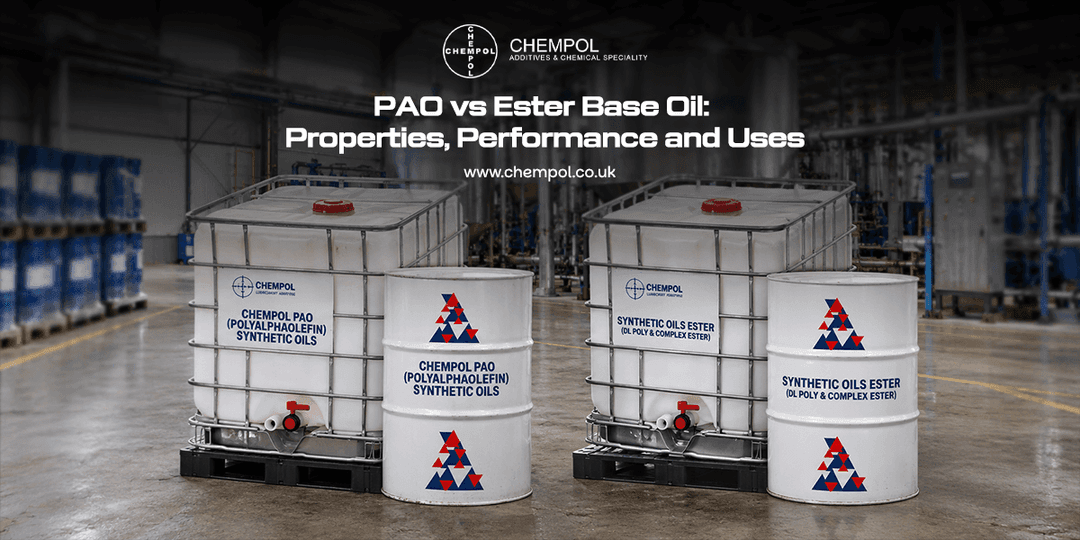
Chempol provides synthetic PAO grades 2, 4, 65, and 150, as well as ester products ES-10, ES-32, ES-68, ES-100, and ES-320.
These product ranges give different starting points for lubricant development. Formulation trials and the current technical documentation should verify the presence of certain characteristics.
Looking for suitable synthetic base oils? Contact Chempol to discuss your lubricant formulation, viscosity requirements, intended applications, and any enquiries about PAO or ester products.
Choosing the Right PAO or Ester Synthetic Base Oil
Knowledge of PAO vs Ester Base Oil enables lubricant manufacturers to create base oils that meet specific industrial or automotive performance requirements.
PAOs are known for their oxidation resistance, desirable low-temperature viscosity, and controlled volatility. Synthetic esters provide polarity, metal-wetting, and additive solvency characteristics that are useful and can be varied to optimize thermal performance based on the chosen chemistry.
Neither base oil is necessarily better. The right one will depend on application needs, formulation compatibility, and validated finished-product performance.
Chempol offers synthetic PAO and ester-based oil products for lubricant manufacturers, blenders, formulators, and industrial users seeking appropriate base oils.
Contact Chempol today for information on synthetic PAO and ester products, technical details, and B2B enquiries. Discuss your formulation requirements and explore suitable synthetic base oil options for your lubricant production needs.