No products found
[email protected]
Gasoline Engine Oil Additives in Pakistan for Modern Engines
Lubricant makers in Pakistan use gasoline engine oil additives to produce motor oil for passenger cars that meets performance levels required to protect the engine, maintain cleanliness, improve fuel economy, and ensure compatibility with emission control systems. The selection of an appropriate additive package is critical for Pakistani oil blenders to formulate competitive lubricants that meet customers’ requirements and industry standards.
Chempol provides a full range of formulation packages for PCMO and Gasoline additives to meet API SN, API SP, and API SQ requirements. These solutions assist the lubricants manufacturer in designing new engine oils for existing vehicle applications and modern gasoline engine technologies.
Understanding Gasoline Engine Oil Additives and Their Importance
Gasoline engine oil additives are chemical components mixed into base oil to improve its performance. They consist of detergents, dispersants, antioxidants, anti-wear additives, and friction modifiers that operate in gasoline engines under varying conditions.
In Passenger Car Motor Oil (PCMO) Formulation, these additives are used to control friction, oxidation, sludge build-up, and engine deposits. Gasoline Engine Oil Formulation Additives also help maintain lubricant performance and thermal stability throughout the oil service life.
The choice of additives is critical to producing uniform-quality engine oils for lubricant manufacturers. The design of an additive package, when correctly formulated, will allow certain performance targets to be reached with selected base oils and viscosity grades.
Why Choose a Reliable Gasoline Engine Oil Additive Manufacturer in Pakistan?
Pakistani lubricant manufacturers provide engine oil for a variety of vehicle types, such as older gasoline automobiles, newer turbocharged automobiles, and imported passenger cars. Different markets demand different lubricant performance levels, viscosity grades, and different formulation strategies.
A trusted Gasoline Engine Oil Additive Supplier in Pakistan is essential for ensuring product quality and seamless blending processes for the manufacturer. Factors such as technical documentation, recommended treat rates, formulation support, and reliable supply arrangements are important.
When looking for a Gasoline Engine Oil Additive Manufacturer in Pakistan, businesses should consider more than just the price; they should assess the supplier’s product range and technical capabilities.
Chempol offers gasoline engine oil additive solutions for a variety of PCMO performance parameters. By offering a product range, lubricant manufacturers can evaluate appropriate additive packages based on their desired API specification, base oil system, and commercial requirements.
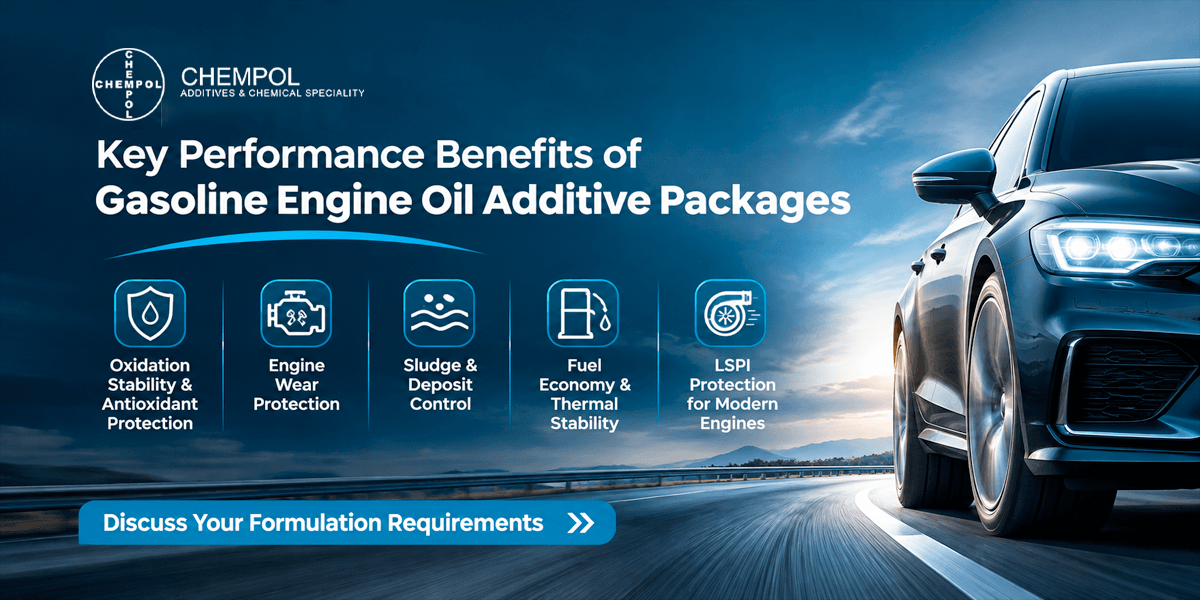
Key Performance Benefits of Gasoline Engine Oil Additive Packages
High-performance Gasoline Engine Oil Additive Packages are blends of chemical components that provide engine protection, lubricant stability, and operational efficiency.
Oxidation Stability and Antioxidant Protection
Gasoline Engine Oil Antioxidant Additives are designed to minimize oil degradation caused by heat and oxygen exposure. Engine Oil Oxidation Inhibitors can help stabilize the oil and prevent formation of undesirable oxidation products while the oil is in use.
Engine Wear Protection
Engine wear protection additives can help form protective layers on critical engine parts, preventing metal-to-metal contact and excessive wear. These additives are critical to engine durability, particularly during extreme driving conditions.
Sludge and Deposit Control
Engine sludge and deposit control additives are used to minimize the formation of harmful deposits and to keep contaminants suspended in the lubricant. Good detergency/dispersancy contributes to engine cleanliness and reduces deposits.
Fuel Economy and Thermal Stability
With properly designed formulations, fuel economy engine oil additives help reduce friction. Thermal stability also contributes to lubricant performance when operating in high-temperature applications, such as today’s passenger car engines.
LSPI Protection for Modern Engines
Low-speed pre-ignition (LSPI) can affect turbocharged gasoline direct-injection engines. LSPI Protection Additives for Gasoline Engines are added to address this problem and to provide wear protection and engine cleanliness.
Discuss Your Formulation Requirements. Contact Chempol to explore additive packages suitable for your passenger car motor oil formulations.
Different Types of Gasoline Engine Oil Additives for Modern Engines
Different gasoline engine technologies require additive packages designed around specific performance standards and engine protection requirements.
API SN Engine Oil Additive Package
API SN additive packages are used in passenger car motor oils designed for the older gasoline engine applications. These remain relevant to lubricant manufacturers in the legacy vehicle market, where this is a suitable performance category.
API SP Gasoline Engine Oil Additives
API SP formulations address wear protection, sludge control, oxidation stability, and LSPI mitigation. An API SP ILSAC GF-6 Additive Package applies to modern engine oils formulated to have these properties.
API SQ Engine Oil Additive Package
API SQ ILSAC GF-7 Additive Package is designed to meet the new requirements for gasoline engine oil, such as LSPI protection and performance in new engine technologies. In 2025, API SQ and ILSAC GF-7 were introduced and are key factors for manufacturers developing next-generation PCMO products.
Low SAPS, Mid SAPS, and Full SAPS Formulations
Low SAPS Gasoline Engine Oil Additives are additives for formulations that require low levels of sulphated ash, phosphorus, and sulphur. Mid SAPS Engine Oil Additive Packages optimize engine protection while maintaining compatibility with exhaust after-treatment.
Full SAPS Engine Oil Additives are recommended for any formulations where the specification allows higher SAPS values.
TGDI and OEM Performance Requirements
TGDI Engine Oil Additives are designed to assist the turbocharged gasoline direct injection (GDI) engine under heavy-duty driving conditions. OEM Engine Oil Additive Packages meet manufacturer performance goals and compatibility concerns.
A VW 504.00/507.00 Engine Oil Additive Package, for instance, demands a unique formulation technique. Chempol also offers CHEMPOL 60801 for mid-SAPS formulations for VW 504.00/507.00.
Before making API or OEM approval claims, manufacturers should check finished-oil test performance and licensing requirements.
Chempol’s Gasoline Engine Oil Additive Packages for Lubricant Manufacturers
Chempol’s gasoline engine oil additive line includes a variety of options that meet the varying API, ILSAC, ACEA and SAPS formulation specifications.
These packages offer lubricant manufacturers options for developing motor oils for passenger cars across various performance categories and market segments.
CHEMPOL 61557
CHEMPOL 61557 is an API SQ and ILSAC GF-7 additive pack for next-generation gasoline engine oils.
It aids modern PCMO formulations for fuel economy, engine cleanliness and wear protection. It applies to gasoline and hybrid-engine oil manufacturers in the development of advanced engine oil ranges.
CHEMPOL 61458
CHEMPOL 61458 is suitable for API SP and ILSAC GF-6 gasoline engine oils.
Performance features include LSPI mitigation, timing chain wear protection, and deposit control. The package is highly relevant to lubricant manufacturers when developing oils for modern TGDI engines.
CHEMPOL 61800
CHEMPOL 61800 is a Mid-SAPS additive package that meets API SP, SN Plus, and selected ACEA C-class formulation targets.
It can be used in the formulation of lubricants and in the development of products for engine cleanliness, LSPI protection, thermal stability, and compatibility with modern exhaust after-treatment systems.
CHEMPOL 63011
CHEMPOL 63011 is designed for API SN, SM and SL motor oil formulations for passenger cars.
It is an additive package that can be used by lubricant producers in existing gasoline engine markets to meet wear protection, oxidation stability, and deposit control requirements.
CHEMPOL 66000
CHEMPOL 66000 is a Mid-SAPS Additive Package for API SN passenger car motor oils and selected ACEA C-class targets.
It is suitable for formulators of engine oils where SAPS limits, engine protection, and exhaust system compatibility are important.
CHEMPOL 63390
CHEMPOL 63390 is a Full-SAPS additive package which is suitable for API SP and API SL formulations.
It offers an alternative for motor oil manufacturers formulating higher viscosity motor oils for passenger cars and for motor oils that meet the applicable ACEA A3/B4 performance requirements.
CHEMPOL 65920D
CHEMPOL 65920D can be used in formulations that meet API SP, ILSAC GF-6, and GM dexos1 Gen 2 requirements.
It covers the protection against LSPI, engine wear, oxidation stability, and deposit control for gasoline engine applications. OEM-related claims need to be verified against finished-oil testing and approval requirements.
Request Product Information and Technical Data Sheets. Enquire About Chempol’s Additive Packages to discuss product specifications, recommended treat rates, compatibility, and commercial availability.