No products found
[email protected]

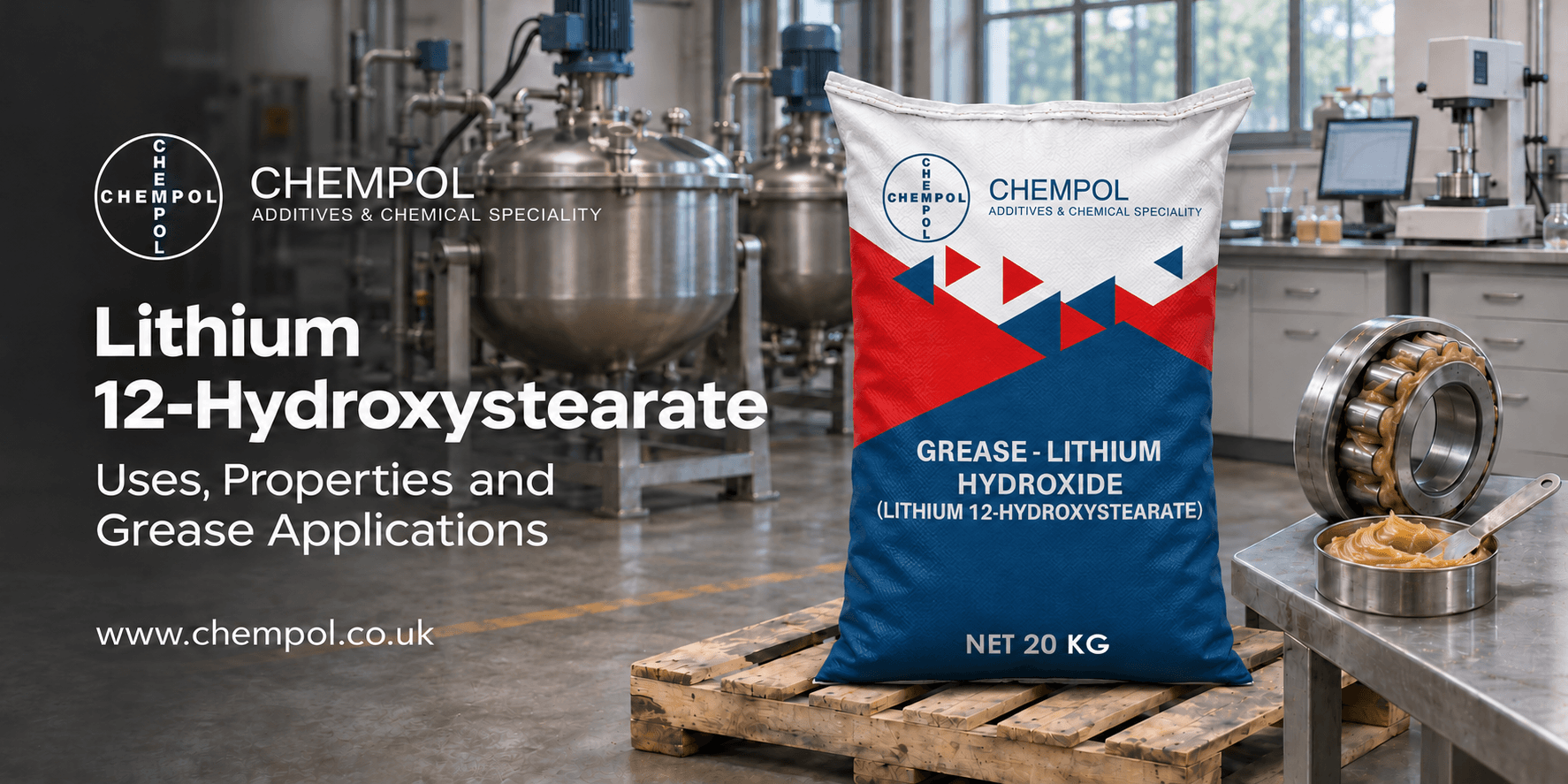
Lithium 12-Hydroxystearate: Uses, Properties and Grease Applications
Lithium 12-Hydroxystearate is a lithium salt of 12-hydroxystearic acid, used to thicken lubricating grease. Lithium hydroxystearate is a specific type of lithium fatty acid salt used to thicken a fluid base oil and form a semi-solid lubricant which can be used in equipment where it is needed. To the grease manufacturer, its significance is that it can give the grease a viable structure, but not that it can replace the lubricating function of the oil.
The proper thickener has an impact on the consistency of greases, oil retention, reactivity to mechanical working, and resistance to environmental conditions. Manufacturers get to know the characteristics when they are designing products for vehicle parts, factory equipment and machines that will see different loads and temperatures.
Chempol has released several lithium grease additives. Manufacturers, lubricant formulators, procurement and distributors that are considering a lithium-based grease raw material should take the time to assess what the chemical identity is, what formulation is intended and what has been recorded to make up the product quality. This guide outlines properties, role of manufacture, applications and sourcing considerations that can help in making an informed inquiry.
Chemical Properties of Lithium 12-Hydroxystearate
The chemical formula of Lithium 12-Hydroxystearate is C18H35LiO3, and its CAS number is 7620-77-1. It is typically defined as a white or off-white crystalline solid or powder, but the appearance of a commercial grade must be checked against a technical data sheet.
Its chemical structure comprises a lithium carboxylate group and a hydroxyl group on a long hydrocarbon chain. Contacts between these groups help lithium soap molecules form structures in which a portion of the base oil is immobilized, and the remainder of the oil is positioned to lubricate working surfaces. These reactions can help explain why the material is a useful thickener for lithium grease.
The compound has a fairly large melting range; however, the melting behavior of the raw material must not be confused with the dropping point of a finished grease. Conventional lithium soap greases can exhibit dropping points in the range of 190-200 C, depending on the formulation and test method. One laboratory property is a lithium soap dropping point, but not necessarily a continuous service-temperature rating.
The lithium soap systems are frequently chosen because they enhance resistance to grease oxidation and structural stability. Nevertheless, the oxidation behavior of a finished grease also depends on the base oil, antioxidant package, processing, and operating conditions. Consumers who evaluate the chemical properties of lithium 12-hydroxystearate should thus distinguish between intrinsic chemical identity and formulation claims.
Role of Lithium 12-Hydroxystearate in Grease Manufacturing
Grease is typically a mixture of base oil, a thickener, and selected performance additives. Lithium 12-Hydroxystearate is used as a lithium soap thickener: it forms a microscopic net in the oil, which provides the final product with its semi-solid consistency and also helps keep the lubricant in the area of contact.
In the production of lithium-based lubricating grease, the formulators regulate the amount of thickener, the choice of base oil, and the heating, mixing, cooling, and finishing processes. These decisions affect the development of the soap network and the success in attaining the desired texture and oil-release properties. An improperly managed procedure may result in bad batches despite the correct initial chemistry.
The material can be added as a pre-prepared soap thickener. Lithium 12-hydroxystearate is also produced in situ by reacting 12-hydroxystearic acid with lithium hydroxide. These are various inputs: Lithium hydroxide is a reactant, but lithium 12-hydroxystearate is the reaction product, a lithium fatty acid salt. Buyers should ensure they quote what the supplier is selling.
A lithium soap grease formulation should strike a balance between mobility and consistency. Excessively soft grease may not stay in place, and excessively hard grease can cause distribution or pumping problems. Worked penetration, oil separation, and stability are normally assessed after mechanical working, rather than selecting a thickener based on a chemical name alone.
For procurement teams, it implies that the raw material for lithium grease manufacturing should comply with the proposed formulation and the factory’s processing method.
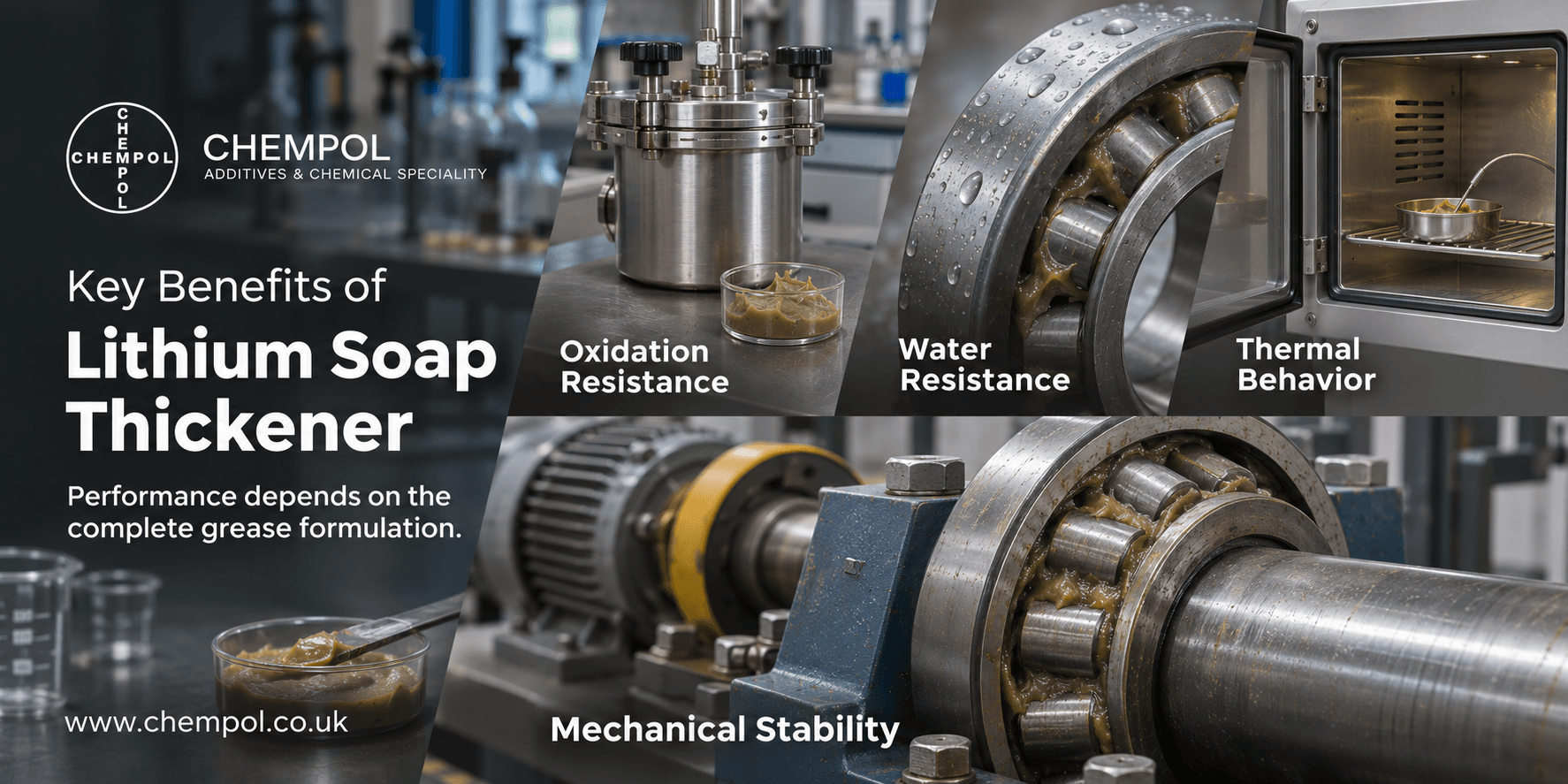
Key Benefits of Lithium Soap Thickener
When properly formulated with oils and compatible additives, a lithium soap thickener can provide a handy balance of characteristics. The practical advantages of the finished grease vary with the specific grease, although four factors make the lithium soap technology applicable to industrial purchasers.
Oxidation Resistance
Lithium soap greases may be formulated with good resistance to deterioration during storage and service. The thickener is part and parcel of the entire system, yet the quality of the base oil, antioxidants, temperature, and air exposure are significant. High oxidation-stability grease thickener alone is not sufficient to ensure long-lasting grease life.
Water Resistance
Lithium soap systems are usually selected in areas where there is the possible contact with incidental moisture or water. A water-resistant lithium grease formulation can help limit washout and grease retention, but the full formulation must pass a suitable water-resistance test. Without supporting test data, water resistance must not be confused with corrosion protection.
Thermal Behavior
An effective lithium grease must have a desirable dropping point and be thermally stable. The volatility of oils, resistance to oxidation, variation in consistency, and exposure time are used to determine whether they are appropriate for the operating temperature. Buyers should demand finished-grease data rather than a single temperature value to determine performance.
Mechanical Stability
In bearings and moving joints, repeated shear can change grease texture. Lithium grease mechanical stability is a significant evaluation criterion of vibration and repetitive motion because well-designed lithium soap systems can maintain useful consistency when at work.
Collectively, these attributes justify why a lithium soap thickener in industrial grease is a viable formulation, as per the actual duty conditions of the equipment.
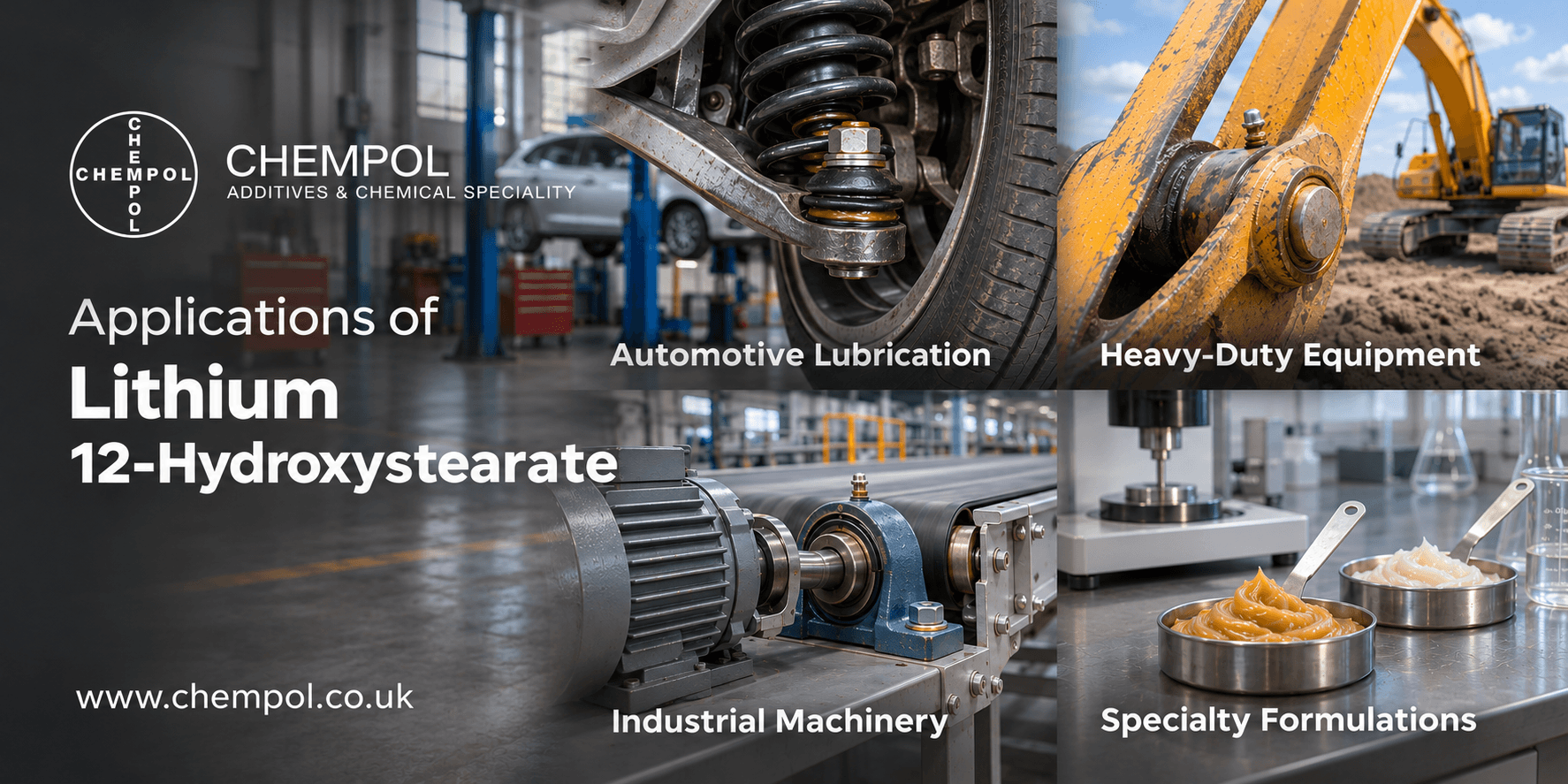
Applications of Lithium 12-Hydroxystearate
Lithium 12-Hydroxystearate is used in production of general and application-specific lubricating greases. Its application covers maintenance of vehicles, industrial machinery and equipment that has to be lubricated with semi solid lubricant rather than free flowing oil. The choice is based on the completed grease specification, rather than on the thickener name.
Automotive Lubrication
A grease thickener for automotive applications may be used in formulations for chassis components, hinges, joints, and selected bearings. Various components have varied requirements of load carrying, water resistance, low temperature movement and relubrication frequency. The automotive wheel-bearing applications, especially, are to be performance tested against the concerned specification.
Heavy-Duty Equipment
Lithium soap for heavy-duty machinery grease is relevant to construction, agricultural, and material-handling equipment. Pins, bushings, and chosen bearings may be subjected to dirt, vibration, and occasional moisture. These conditions require the selection of the base oil and extreme-pressure or anti-wear additives; the soap itself does not determine load capacity.
Industrial Machinery
Lithium-soap greases may be used in the motors, general bearings, conveyors and maintenance points of the factories where it is advantageous to retain the oil. Choosing an appropriate grade of grease, the formulators consider the speed, operating temperature, compatibility with seals, and the risk of contamination.
Specialty Formulations
The use of Lithium soap technology can also be thought of with the chosen synthetic base oils or other customized additive systems. These applications demand compatibility and trial processes, as opposed to a direct supposition that all lithium thickeners are compatible with all oils.
This breadth of use can make screening of early formulations easier to manufacturers, with room to test and differentiate products application-specifically.
Factors to Consider When Selecting a Lithium Grease Raw Material
Choosing a raw material lithium grease is a technical and a buying decision. Even the lowest quoted price is seldom sufficient data to predict processing behavior or consistency of finished batches of grease.
Begin by checking the chemical name and CAS number. Lithium 12-hydroxystearate and lithium hydroxide are not interchangeable although they may both be used in the manufacture of greases. Request the potential supplier of lithium 12-hydroxystearate to specify the material that is being sold and to present the related documentation.
Second, check relevant specifications such as appearance, assay or composition, moisture, and free fatty acid or alkalinity where applicable, particle characteristics and the test methods mentioned. The parameters that will be useful will depend on the commercial grade and manufacturing route. Safety data sheet also plays a role in the handling, storage and transport planning.
Consistency between batches is worth consideration, as deviations can have an impact on dispersion, process time, output, or ultimate texture of greases. Enquire about the method of communicating specifications and the possibility of providing batch specific documents.
Lastly, evaluate application requirements and business fit. Provide your type of base oil, the grade you want to be used in production, production process, market where you will sell, the order quantity, and the mode of delivery. These specifications can assist a supplier of lithium soap thickener to decide what details are required to make a significant quotation and technical evaluation.
Why Choose Chempol for Lithium 12-Hydroxystearate?
Chempol provides grease additives and other specialty materials to manufacture lubricants and greases. Our published range consists of a lithium-related products list and thus, the company can be viewed as a good contact point among buyers researching lithium soap grease formulation and related raw materials.
In the case of B2B buying, a successful query extends beyond a product name. Manufacturers should determine what chemical is being sold, what grade is being sold and whether the characteristics that are being sold are what is intended to be used in a formulation. The procurement managers should also be able to understand the packaging, commercial terms, lead times and documentation that apply in their buying procedure.
Always seek clarification regarding the specific product designation and provide the technical data sheet of the product before actualizing a purchase with Chempol. The separation of a pre-made lithium soap thickener, as opposed to its production materials assists buyers in comparing quotations precisely and prevents unnecessary production problems.
When you are bidding a new supplier of lithium 12-hydroxystearate, or checking out current sourcing alternatives, a clear technical brief can result in a more fruitful conversation. Get in touch with Chempol about your material needs and request product information, support documents, and commercials to use in your project.
Request Lithium 12-Hydroxystearate Information from Chempol
Lithium 12-Hydroxystearate may have a significant role in grease structure and flexing in formulations, however, sourcing Lithium 12-Hydroxystearate successfully starts with the verified material identity and the clear technical requirements. When your company is planning to either develop or acquire lithium-based grease materials, send Chempol your planned use and purchase requirements.