[email protected]

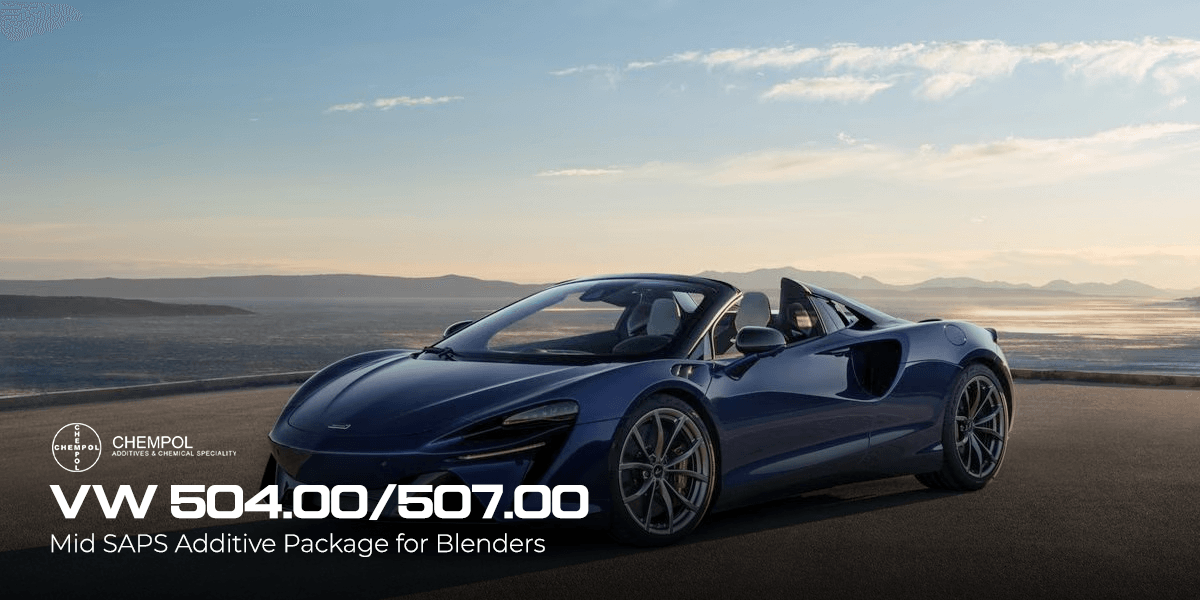
VW 504.00/507.00 Mid SAPS Additive Package for Blenders
Modern engine oils are becoming harder to formulate as engines run hotter, emission systems become more sensitive, and OEM specifications demand tighter control of deposits, wear, oxidation and after-treatment compatibility. For lubricant manufacturers, it is no longer so simple to create oil that lubricates well. A completed product is also required to safeguard diesel particulate filters, catalysts, and emissions hardware, and to facilitate extended service life and modern engine performance.
This explains why a VW 504.00/507.00 Mid SAPS Additive Package has gained strategic relevance for oil blenders aiming to produce premium European passenger-car lubricants. Mid SAPS technology assists with a trade-off among engine protection, Diesel particulate filter (DPF) protection, Selective catalytic reduction (SCR) compatibility, and Three-way catalytic converter protection. ACEA classifies C3 oils as Mid SAPS lubricants that are after-treatment-compatible and have a minimum HTHS viscosity of 3.5 mPa s.
Chempol assists lubricant manufacturers, private-label brands, distributors, and formulators with additive technologies designed to meet these challenging performance goals. As companies in the US look to align with European OEM standards, one step in the right direction is to understand the formulation strategies for VW 504.00 and VW 507.00.
Discuss Your Formulation Requirement with Chempol
Developing a new European passenger-car motor oil or upgrading an existing range? Contact Chempol to discuss your target viscosity grade, base oils, performance level, market positioning and production requirements.
Why Modern Engines Need Mid SAPS Technology
Sulfated Ash, Phosphorus and Sulfur are abbreviated as SAPS. These chemical contributors are linked to additive components that can confer valuable functions such as detergency, anti-wear protection, and oxidation control. However, a high concentration may cause issues for modern exhaust after-treatment systems.
Non-combustible ash may build up in particulate filters over time in diesel applications. That decreases available filter capacity and may increase the service burden. Phosphorus may also influence catalyst efficiency, and the level of sulfur should be managed with caution in formulations used to meet modern emission systems.
That is why the trend in European passenger-car engine oils is toward an increasingly Reduced SAPS (Sulfated Ash, Phosphorus, and Sulfur) additive approach. An adequately balanced sulfated ash control additive system and a phosphorus-controlled additive strategy can help formulators protect the engine and emissions equipment.
C categories of ACEA are specifically designed to be used with catalyst- and particulate-filter-compatible oils. ACEA C3 is a stable, stay-in-grade Mid SAPS gasoline and direct-injection diesel engine oil used with after-treatment systems and extended-drain applications where specified.
For lubricant manufacturers, the value is practical: Mid SAPS chemistry enables the development of an emission-system-compatible additive platform for modern gasoline or diesel engine oils without compromising the desired protection of a high-performance engine lubricant.
VW 504.00/507.00 Mid SAPS Additive Package: What Specs Demand
VW 504.00 and VW 507.00 are Volkswagen Group engine oil standards for demanding gasoline and diesel applications. VW 504.00 is for gasoline engines, whereas VW 507.00 is for diesel engines, including those with particulate filters. Volkswagen recommends that owners use VW-standard engine oil, including for warranty coverage.
VW standards are closely tied to long-drain engine oil technology and the concept of LongLife services. They are usually placed in VW LongLife III requirements; finished oils are designed based on their oxidation stability, deposit control, wear protection, viscosity retention, and compatibility with the emissions system. There are approved products in 0W-30 and 5W-30 synthetic formulations.
For blenders, a VW LongLife III additive package is not merely about achieving a low ash figure. The entire formulation should be able to control wear, ensure cleanliness, and provide long service life under high-temperature, turbocharging, and direct-injection conditions.
Fuel economy is also a concern, but it must be balanced against viscosity and HTHS requirements. A premium engine oil formulation should have friction performance without compromising the film strength.
A significant commercial aspect is that OEM approval is typically accorded to the finished lubricant, rather than to the additive package itself. Manufacturers must consequently verify the finished oil against the testing, documentation and approval status of the claims that they plan to make.
Challenges Faced by Lubricant Manufacturers
Formulating a high-quality European passenger-car engine oil poses several technical and business issues simultaneously.
After-Treatment Protection
The oil should restrict the use of ash-forming components and still retain the detergency, anti-wear protection, and oxidation inhibitor.
Long-Drain Durability
Long service life puts additional pressure on the viscosity stability, cleanliness, and oxidation resistance.
OEM Test Complexity
Various OEMs use their test sequences and approval process; this raises the cost of development and technical risk.
Multi-Standard Positioning
Blenders frequently desire a single platform of formulation to support ACEA and multiple European OEM needs with minimum complexity.
Base-Oil Sensitivity
It is a phenomenon whereby the same additive package may act in different ways depending on the quality of base stock, viscosity balance, and final formulation design.
Commercial Consistency
Private-label brands and distributors need repeatable batch quality, technical documentation and reliable supply as volumes grow.
The additive selection is a strategic choice to these pressures. There is the possibility of excess deposits, unstable viscosity, inadequate wear control, or incompatible emissions equipment in case of a weak or poorly matched package. It may also compel the blender to re-engage in re-forming the product, further laboratory experiments, and reduced product launches.
How CHEMPOL 60801 Solves These Challenges
CHEMPOL 60801 is an advanced-technology Mid SAPS engine oil additive used in high-quality gasoline and diesel engine oils that have advanced exhaust after-treatment systems. It is formulated to assist the development of formulations to meet API SN, ACEA C3, and VW 504.00/507.00 performance and aids in controlling the sulfated ash, phosphorus, and emissions-system compatibility.
The product is priced at 8.5 wt% in the API SN and ACEA C3 formulations of SAE 0W-30 and SAE 5W-30 viscosity grades at their recommended treat rate. The product is complementary to the oils that are used in engines with DPF, SCR, and three-way catalytic converters and also in pump-injector applications.
For lubricant manufacturers, it offers a viable Mid SAPS & VW 504.00/507.00 Additive Package, which is concerned with:
- Reduced ash formation for after-treatment protection.
- Catalyst-compatible phosphorus control.
- Detergency and cleanliness for demanding passenger-car engines.
- Wear and oxidation control for extended-drain operation.
- Support for synthetic engine oil technology.
- Compatibility with premium European gasoline and diesel applications.
It can also be used as an ACEA C3 additive Package, a premium engine oil additive platform, and a pump-injector engine oil additive solution in a duly designed finished oil.
Applicability is also found with synthetic engine oil technology additive systems where the ultimate performance is determined based on the interaction of the package, viscosity modifier, pour-point depressant and chosen base oils.
The relationship with suppliers may extend beyond the additive. According to the company, its technical team helps with formulation requirements, tailor-made additive solutions, technical documentation and bulk supply. That enables B2B buyers to negotiate treat rate, performance objectives, base-stock approach and trade-off commercial scale-up instead of just price per kilogram.
Request CHEMPOL 60801 Technical Support
If you are evaluating a VW 504.00/507.00 Mid SAPS Additive Package, contact Chempol to request the product datasheet, discuss sample availability, review recommended treat rates, and obtain formulation guidance for your target SAE grade and performance level.
Applications and Recommended Formulations
CHEMPOL 60801 is aimed at the development of high-end passenger-car lubricants where Mid SAPS performance and European specification coverage are critical. Its technical information reveals that SAE 0W-30 and SAE 5W-30 are recommended viscosity grades in its given 8.5 wt% treat rate of API SN and ACEA C3 performance. Typical formulation directions include:
- SAE 0W-30 oil formulation for low-temperature flow, synthetic performance, and European passenger-car applications.
- SAE 5W-30 oil formulation of the popular gasoline and diesel engine-oil ranges.
- Synthetic passenger-car motor oils for turbocharged and direct-injection engines in modern engines.
- Long-drain lubricants in which the OEM and service requirements are verified.
- DPF- and catalyst-compatible oils for modern European fleets.
- Premium private-label products with a focus on existing European performance positioning.
Because the final performance claim depends on the complete oil, formulators should evaluate base-oil selection, viscosity index improver, cold-flow behavior, volatility, HTHS viscosity and additive treat rate as one system.
This is more so when a manufacturer desires to develop a high-performance engine lubricant with a number of claims. An effective formulation should be proven to be a full finished oil and not that a single additive package would automatically pass on all approvals.
Why Global Lubricant Manufacturers Choose Chempol
Additive chemistry is just a component of supplier selection in the case of B2B buyers; just as much can influence production reliability as technical access, documentation, quality consistency, and logistics.
The firm identifies itself as a supplier of global lubricant additives with technical assistance, tailor-made formulations, bulk supply, and global logistics assistance. Its publications also point out technical information, safety reports and formulation support for lubricant manufacturers. That matters because different buyers need different support:
- Lubricant manufacturers need repeatable additive quality and dependable supply.
- Oil blenders need clear treat-rate and formulation guidance.
- Private-label brands need scalable products with credible premium positioning.
- Distributors need technical answers for downstream customers.
- Formulators benefit from broader additive expertise for future portfolio development.
Our technical team is also capable of facilitating negotiations on custom formulations, product optimization, and commercial volume needs. For companies entering European passenger-car lubricants, this mix of additive technology, technological support, and supply capacity can streamline development and make it more business viable.
Start a B2B Supply or Formulation Discussion
Contact Chempol for an RFQ, distributor inquiry, partnership discussion or OEM-focused formulation project. Share your target specifications, viscosity grade, base-oil system, expected annual volume, and market so the technical and commercial teams can evaluate the right supply route.