[email protected]

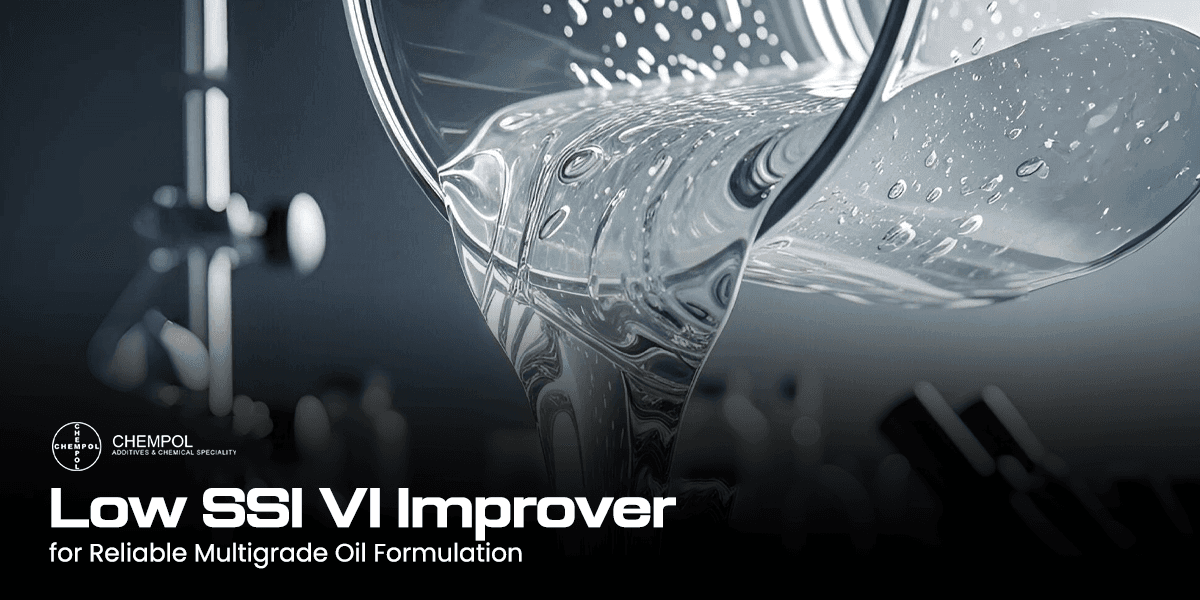
Low SSI VI Improver for Reliable Multigrade Oil Formulation
Viscosity loss is an expensive weakness in any lubricant formulation. An oil can achieve its fresh-oil viscosity target, but with repeated mechanical shear, high operating temperatures, and extended service, its viscosity-enhancing contributions can diminish over time. The outcome may include subpar oil-film protection, unpredictable field performance, unnecessary pressure on maintenance staff, and an increased risk of customer dissatisfaction.
Chempol 5026 - LOW SSI VI Improver (Liquid Form) will address that obstacle at the formulation level. It is based on a shear-stable amorphous Ethylene-Propylene copolymer, it carries multigrade crankcase and industrial oils which require long-term viscosity stability, reliable low-temperature fluidity, and convenient blending versatility.
The product delivers an effective balance of shear stability, pour-point performance, liquid-form handling, and compatibility with synthetic and mineral oils for manufacturers seeking a Low SSI VI Improver that works across a wide range of SAE grades. That makes it a good choice for formulators interested in extending lubricant life without introducing additional complexity to the manufacturing process.
Why Viscosity Loss Creates Costly Problems for Lubricant Formulators
Viscosity does not just specify a value. It affects the thickness of the oil film, pumping characteristics, friction management, and load protection of moving surfaces by a lubricant. Because a viscosity modifier is highly susceptible to mechanical degradation, the finished lubricant may lose some of the viscosity contribution incorporated into the initial formulation.
Polymeric viscosity modifiers are repeatedly strained in crankcase oils, bearings, valve trains, pumps, and other high shear areas. The same can be required of industrial equipment, including hydraulic pumps, gear sets, compressors, and highly loaded circulation systems. When the additive cannot withstand irreversible degradation, the retention of viscosity in engine oils or industrial products can shift outside the formulator's performance window.
The technical loss turns into a business problem. It may cause reduced useful oil life, reduced formulation margin, increased maintenance requirements, and reduced protection under severe service. For lubricant brands, unreliable viscosity performance can also intensify reformulation efforts and degrade product differentiation.
A Low SSI VI Improver can be chosen to minimize that risk by maintaining a higher desired lubricant viscosity under mechanical stress. A constant Industrial Oil Viscosity Modifier thus helps with not only technical performance but also predictable product quality and reduced formulation uncertainty.
Understanding Low SSI VI Improver Technology and Why SSI Matters
Shear Stability Index, or SSI, indicates how much viscosity contribution a polymeric viscosity modifier may lose after mechanical shearing. Practically, a reduced SSI corresponds to an increased ability to withstand permanent viscosity breakdown.
This difference is important since a viscosity improver must not just be able to bring a fresh blend to its desired grade. It must also not lose valuable viscosity contribution when the lubricant has been subjected to hours or thousands of kilometers of mechanical strain.
Chempol 5026 features a shear-stable amorphous Ethylene Propylene Copolymer, developed for multigrade crankcase oils and other industrial applications. As an EPC Viscosity Index Improver, it helps formulators balance viscosity control at operating temperatures with low-temperature lubricant performance.
The Ethylene Propylene Copolymer platform is particularly applicable in cases where wide-temperature operation is required. When used in an SAE multigrade oil formulation, the additive must increase viscosity at elevated temperatures but should not impose unnecessary cold-flow penalties. Another urgent need is maintaining the contribution of viscosity in service, which a low shear-stability-index additive focuses on.
For developers considering a Viscosity Index Improver for engine oils, this combination will make low SSI technology a performance choice rather than a mere thickening choice. It helps bridge the gap between fresh-oil targets and the long-term behavior expected of the finished lubricant.
How Chempol 5026 Delivers Long-Term Viscosity Stability
A viscosity modifier can only deliver value when it is effective within the complete formulation. The additive is designed around three priorities: shear durability, low-temperature flow, and ease of blending.
Exceptional Shear Stability
The product is a High Stability VI Modifier with low SSI properties that help the final lubricant retain its viscosity without permanently losing it under extreme mechanical conditions. This helps retain viscosity in multigrade crankcase oils over time and in other applications that may experience performance decline due to polymer breakdown.
In the case of the formulators, the high retention of viscosity can minimize the tendency to overbuild the initial viscosity merely to counter the expected future shear loss. That provides a more rigorous formulation plan and helps sustain more predictable oil-film performance over the planned service life.
Low SSI VI Improver is thus not only compliance-enhancing in the laboratory. It helps protect the formulator’s original performance intent after the oil enters demanding real-world operation.
Superior Low-Temperature Performance
Multigrade lubricants should be able to operate in varying temperatures. High viscosity at operating temperature is only useful when the oil can also circulate during cold starts or low-temperature operation.
This additive improves low-temperature fluidity and pour point performance, enhances cold-temperature flow of oil, and retains shear stability at high temperatures. It is also compatible with pour-point depressants and offers more options for development teams seeking to optimize low-temperature lubricant performance.
It is a critical balance in engine oils and industrial products where pumpability, start-up lubrication, and viscosity control should collaborate.
Easy Formulation and Blending
The product is distributed in liquid form, which makes it easier to handle and add to the base-oil system. Simple dosing and mixing can facilitate quicker processing and more reproducible production.
It is also compatible with both mineral and synthetic base stocks, providing more flexibility for formulators during development. One Low SSI VI Improver platform can be tested across many product families, helping simplify raw-material planning and reduce unnecessary complications in formulations.
For manufacturers who scale from experiments to commercial batches, these handling benefits can be translated into faster introduction and more efficient technical development.
When your formulations need higher-viscosity hold and better low-temperature performance, the Chempol technical team will be happy to assist in determining the proper treatment rates and formulation strategy for your application.
Why Chempol 5026 Outperforms Conventional VI Improver Approaches
Not all viscosity modifiers are optimized towards the same goal. Certain traditional methods provide good initial thickening and impose compromises in permanent shear loss, cold-flow characteristics, or processing efficiency. It is important to achieve the target viscosity at the start, but without it, sustained viscosity performance cannot be ensured.
The additive provides a more balanced route. Its low SSI properties promote viscosity retention following mechanical stress, whereas its low-temperature behavior is useful, allowing formulators to chase fluidity and pour point targets. The presence of liquid-form supply and wide base-stock compatibility also enhances formulation flexibility.
Such a mix can reduce the number of compromises technical teams must make. Formulators no longer need to choose a single additive to build viscosity. Then heavily offset shear or low-temperature constraints in other areas; they can begin with a High Stability VI Modifier that simultaneously meets multiple performance priorities.
That alters the value calculation for procurement managers. A consistent Industrial Oil Viscosity Modifier must be evaluated not only on purchase or treatment price but also on its contribution to formulation stability, production effectiveness, and reduced redevelopment efforts.
An EPC Viscosity Index Improver with such attributes can create value across technical, operational, and commercial functions.
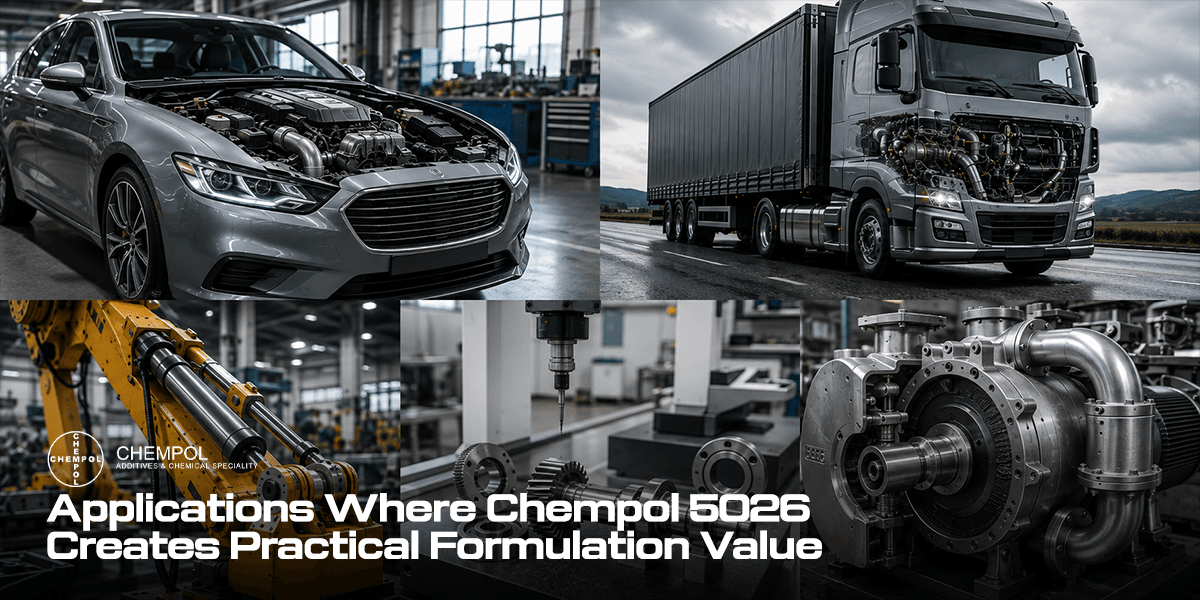
Applications Where Chempol 5026 Creates Practical Formulation Value
The product is designed for multigrade crankcase oils and provides useful properties for the formulation requirements of selected industrial lubricants.
Passenger Car Engine Oils
In passenger car engine oils, it can enable multigrade viscosity goals and help maintain viscosity after a series of mechanical stresses. It is effective as a Viscosity Index Improver for engine oils that require stop-start operation, varying temperatures, and extended service life.
Heavy-Duty Diesel Engine Oils
In heavy-duty diesel engine oils, viscosity retention is further challenged by long operating hours and high mechanical loads. A Low SSI VI Improver is capable of ensuring a more consistent viscosity profile in such challenging conditions.
Hydraulic and Industrial Oils
The additive can be used in hydraulic and industrial oils to support applications requiring viscosity control across a wide operating temperature range. It can be used as an industrial oil viscosity modifier, with formulation goals that include pumpability, stable viscosity, and long service life.
Gear and Compressor Oils
Shear resistance and viscosity stability can be valuable in gear and compressor oils where the lubricant is subjected to a constant mechanical load or prolonged operating cycles. The ultimate suitability is always determined in the entire additive system and targeting specification.
Synthetic and Mineral Oil Compatibility
Its ability to mix with synthetic and mineral oils also provides manufacturers with the flexibility to utilize the technology across various base-stock strategies. It can streamline the development of portfolios of companies that manufacture multiple SAE grades, crankcase products, and industrial lubricants.
Commercial Benefits for Lubricant Manufacturers and Formulators
The strongest additive decisions relate to lab performance and business results. A constant viscosity modifier can minimize formulation uncertainty, enhance batching consistency, streamline plant management, and strengthen the story behind the final lubricant.
For technical teams, low SSI values contribute to more trustworthy long-term viscosity stability. That provides formulators with a better foundation to base products on realistic service performance rather than fresh-oil viscosity per se.
For production teams, liquid-form handling can simplify storage, dosing, blending, and scale-up. Additional operational efficiency can also be achieved by more readily incorporating mineral and synthetic base stocks when a plant manufactures multiple product families.
For commercial teams, more stable viscosity performance enables greater product differentiation. Customers require that an engine or industrial oil be reliable during the service period for which it was intended. An appropriately chosen lubricant performance enhancer helps manufacturers compete on performance consistency rather than solely on grade claims.
For procurement teams, it is not just the additive. Collaborating with a technically oriented supplier will enhance communication regarding formulation goals, compatibility, and application fit. That can shorten decision cycles and save the expense of repeated trial-and-error development.
A Low SSI VI Improver must thus be considered as a subsumed portion of the overall value of the completed lubricant: retention of performance, production viability, portfolio flexibility, and customer confidence.
Why Leading Formulators Choose Chempol—and Why Evaluate 5026 Now
The development of lubricants seldom succeeds solely based on additive selection. The formulators must also have the same product quality, supply reliability, and responsive technical communication and assistance from laboratory concept to commercial blend.
Chempol, as a technical partner, assists with real formulation requirements in testing Chempol 5026. Shear-stable Ethylene Propylene Copolymer additive is an additive for multigrade crankcase oils, selected industrial applications, compatible with pour point depressants, and compatible with mineral and synthetic base-stock strategies.
When balancing SAE grade targets, compatibility of crankcase oil additive packages, low-temperature performance, shear stability, and production constraints, technical assistance comes in especially handy. The focus is not merely on introducing viscosity but on creating a complete lubricant that is stable, manufacturable, and economical.
It can be costly to delay progress in viscosity control, which may lead to persistent shear loss, unnecessary formulation complexity, or low-temperature non-uniformity. In competitive manufacturing of engine oil and industrial lubricants, such trade-offs can become more costly as product expectations rise.
That low SSI, long-term viscosity retention, low fluidity at low temperatures, wide base-stock compatibility, and liquid form handling make the product worth considering in environments where both durability and processing efficiency are important.
Ready to improve lubricant performance with a proven Low SSI VI Improver? Contact Chempol today to discuss your formulation requirements, request technical guidance, or obtain a product sample. Our experts are ready to help you develop more stable, high-performing lubricants.