[email protected]

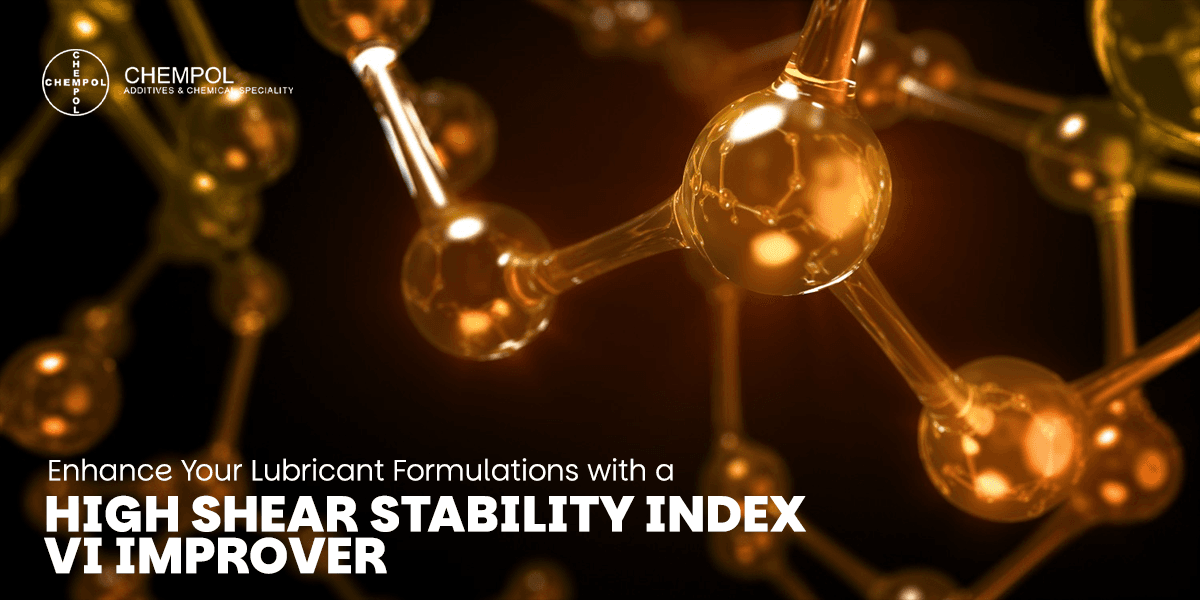
Enhance Your Lubricant Formulations with a High Shear Stability Index VI Improver
Loss of viscosity and breakdown of oil under stress are common issues encountered by lubricant producers that result in reduced engine protection, increased wear, and shorter product life. The most important factor in ensuring optimal lubricant performance is the shear stability index (SSI). Lubricant formulators can gain a lot by understanding and maximizing SSI, which will lead to higher levels of protection and longer engine oil life.
To enhance shear stability, Chempol offers advanced solutions with shear-stable VI improvers that improve oil performance in severe conditions. Chempol has years of experience developing high-performance additives, so it can provide you with a reliable, consistent formula to counter viscosity loss for your customers.
Contact Chempol to improve your lubricant formulations with shear-stable solutions that perform under stress.
What is the Shear Stability Index in Lubricants?
Shear stability index (SSI) is a critical parameter that determines a lubricant's ability to remain viscous under mechanical stress or shear forces. Viscosity index (VI) improvers are polymers that are crucial in maintaining the thickness and protective nature of lubricants as they are used. However, these polymers may deteriorate under specific conditions, leading to a loss of viscosity and performance.
Polymer molecules may break apart when lubricants are subjected to high shear forces, thereby decreasing the oil's ability to maintain viscosity. Such degradation may result in engine parts being poorly lubricated, becoming more worn, and eventually becoming oily. To lubricant manufacturers, the SSI is a crucial concept that can be studied and optimized to make oils that would work reliably in harsh environments.
Why Shear Stability in Engine Oils Matters
Engine protection, oil life, and performance stability are directly related to shear stability. Since engine oils are subjected to continuous mechanical stress, especially in high-temperature, high-speed environments, a lack of shear stability can lead to a loss of viscosity. This may cause several problems:
- Poor engine protection as a result of a lack of lubrication.
- Excessive wear and tear of engine parts.
- Reduced life of oil, and it demands more frequent oil changes.
Low-shear-stability lubricants are unable to maintain their viscosity when subjected to such stresses, which causes engine damage and additional inefficiency in operation. For lubricant manufacturers, selecting oils with the best shear stability is important for maintaining the protection, reliability, and efficiency of the engine in the long run.
Role of VI Improvers in Multigrade Oils
Multigrade oils contain viscosity index (VI) improvers, which enable them to operate over a broad temperature range. VI improvers are polymer additives that enable lubricants to retain viscosity and do not overly thin at elevated temperatures, while enhancing flow at low temperatures. The performance of these improvers directly affects the oil's performance under different operating conditions, especially for SAE grades.
Shear stability of VI improvers dictates their ability to withstand mechanical stress-induced degradation, so that oils retain their viscosity and protection properties during service. Through shear-resistant VI improvers, lubricant producers can enhance cold-start lubrication, engine protection, and prevent oil viscosity from changing due to temperature variations.
How to Improve Viscosity Stability in Oils
Lubricant manufacturers should consider using shear-stable VI improvers to stabilize oil viscosity and prevent shear degradation. These improvers are meant to resist high shear forces, and hence the viscosity and performance of the oil under stress. Besides using shear-stable VI improvers, there are other measures that manufacturers can adopt to enhance the stability of viscosity:
- Better long-term viscosity retention with low SSI VI improvers.
- Use polymer additives that increase shear stability without affecting performance.
- Optimize oil formulations to ensure compatibility with a broad selection of base oils and additives.
These measures assist manufacturers in developing oils that are more protective and last longer on engines, and this eliminates the frequent changes of oils and also minimizes the chances of engine failures.
Why Low SSI Viscosity Improvers Are Critical
Low SSI viscosity improvers are used in the need to ensure that lubricants can remain stable in their viscosity even during long durations of use, particularly in high-shear applications. As opposed to high SSI improvers, which can provide initial viscosity improvement before degrading, low SSI improvers can maintain their viscosity properties longer, with long-term benefits:
- Less viscosity loss in the presence of high shear rates.
- Better long-term engine protection and better consistency in oil performance.
- Increased product reliability, which results in fewer oil-related failures.
Manufacturers of lubricants can maximize the long-term performance of their products using low SSI VI improvers, and in this way, they are able to match the needs of high-performance engines and industrial equipment.
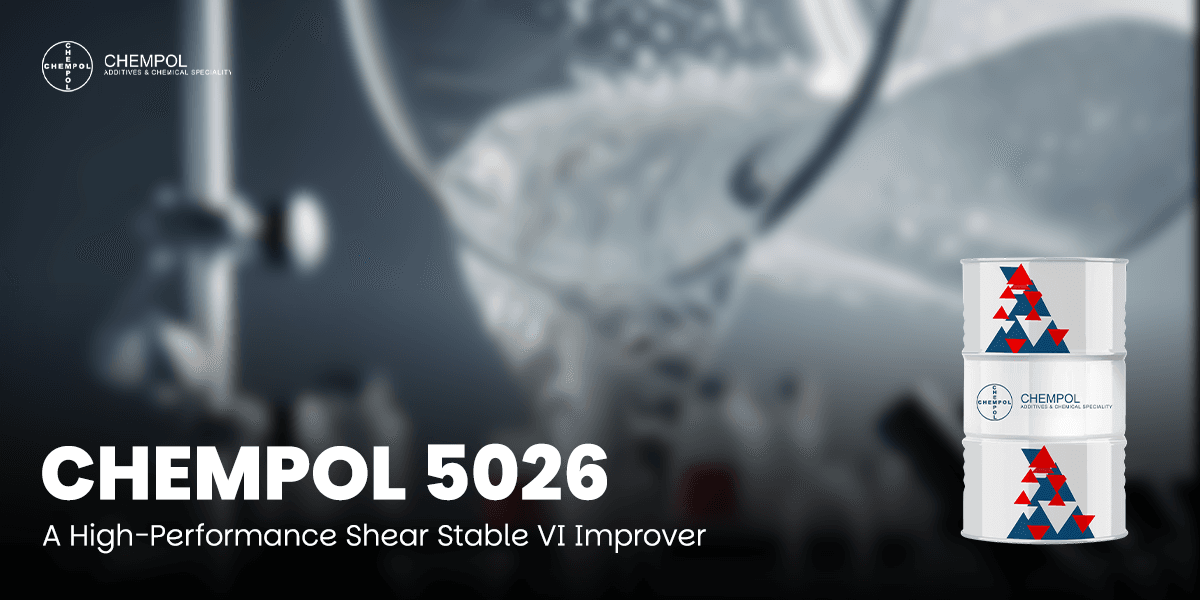
CHEMPOL 5026 – A High-Performance Shear Stable VI Improver
CHEMPOL 5026 is a high-performance shear-stable VI improver that can be used to resolve the issue of viscosity stability in lubricants. It has good viscosity retention and shear degradation resistance, which ensures the performance of oils at high stress levels within low SSI. Moreover, it provides:
- Excellent shear stability, retention of viscosity in high stress situations.
- High-quality performance at low temperatures, enhancing cold start lubrication.
- Pour point improvement, increasing low-temperature fluidity.
CHEMPOL 5026 can be used with mineral and synthetic oils, thus suitable for a variety of lubricant formulations. With CHEMPOL 5026, manufacturers are able to enhance the performance of their products in harsh applications, including automotive oils, as well as industrial lubricants.
Request a technical datasheet or pricing from Chempol today and learn how our shear-stable solutions can enhance your formulations.
Benefits for Lubricant Manufacturers
Many benefits can be enjoyed by lubricant manufacturers that use high-performance shear-stable VI improvers such as CHEMPOL 5026, which include:
- Stable viscosity performance over a broad range of operating conditions.
- Less risk of oil failure, which results in fewer engine problems and downtime.
- Better product quality, meeting industry demands for reliability and performance.
Manufacturers will be able to add more stability to their products by inserting shear-stable solutions so that their products will be competitive in the markets.
Get in Touch with Chempol Today
Shear stability index is crucial in making sure that lubricants will not lose their viscosity and protective characteristics when subjected to mechanical forces. Lubricant manufacturers are able to maximize the retention of viscosity, minimize oil degradation, and increase the life of their products by using high-performance shear-stable VI improvers.
The shear-stable solutions of Chempol provide a solid means of making sure that your lubricants will always perform well, protecting your engine and reducing the maintenance requirements. Contact Chempol today and get the shear-stable VI improvers into your lubricant formulations and make your products the best.