[email protected]

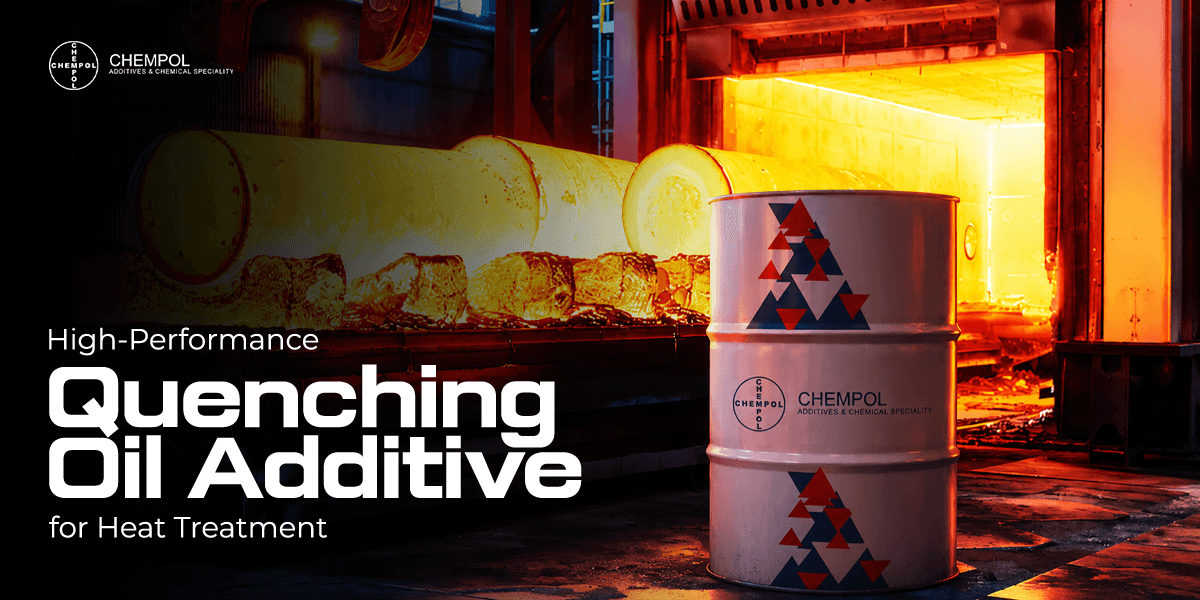
High-Performance Quenching Oil Additive for Heat Treatment
In industry, poor quenching performance is seldom a minor technical factor. Oxidation, sludge, irregular cooling, oil degradation, steel cracking, and component distortion may soon be costly issues in production. Once a quenching bath becomes thermally unstable, manufacturers are likely to have rejected parts, rework, maintenance, and downtime, increased processing expenses, and untimely oil changes.
A high-performance quenching oil additive assists in managing these risks since it improves the cooling behavior, oxidation resistance, cleanliness and life of the base oil. Ordinary quenching oils cannot be relied upon to stay the same with each production batch unless they have an efficient additive package to prevent degradation during repeated heat cycles.
CHEMPOL 5079 Quenching Oil Additive
This quenching oil additive package, created by Chempol, is a multi-purpose additive designed to be utilized in the formulation of both hot and cold quenching oils in metal heat treatment. It enhances uniform quenching rate, oxidation stability, thermal resistance and homogenous hardening. CHEMPOL 5079 assists in minimizing sludge, deposits, acidity, metal staining, cracking and distortion, which means that industrial users can maintain the quality of their products without compromising on the operating costs.
Speak with Chempol’s technical team about your heat treatment requirements. Request a consultation for formulation guidance, customized recommendations, and commercial supply options for CHEMPOL 5079.
What is a Quenching Oil Additive?
A quenching oil additive is a performance additive chemical package incorporated in appropriate base oils to create a controlled metal hardening process oil. It has more than just an oil life-increasing role. The additive affects the level of reliability of the fluid in removing the heat of the hot metal parts in the process of quenching.
Cooling properties of a quenching medium have a direct influence on hardness formation, dimensional stability, surface finish and metallurgical uniformity. When the cooling rate is too rapid in the critical temperature ranges, there is a danger of cracking and distortion. When cooling is too slow or intermittent, components cannot reach the necessary hardness or microstructure.
The new generation of industrial quenching oil additives is thus designed to assist in controlled cooling, oxidation defence, deposit resistance and process repeatability. A sophisticated quenching oil additive package should be able to carry on its working in case it is subjected to recurring conditions of hot metal components, oxygen, contaminants, and extended production cycles.
CHEMPOL 5079 is developed as a multifunctional quenching oil additive for both hot and cold quenching purposes. It improves the cooling properties of base oils and quenching stability and thermal resistance of oil oxidation. This provides a more reliable formulation that can be used to maintain a consistent rate of metal cooling and a consistent hardening behaviour in repeat batches.
In the case of heat treatment plants, this dependability minimizes manufacturing uncertainties. In the case of lubricant formulators, CHEMPOL 5079 is an attractive performance-oriented additive package that allows high oxidation resistance at high temperatures, enhanced cleanliness and longer cooling rate and life.
Industrial Problems Caused by Poor Quenching Oils
Below are some of the industrial problems caused by quenching oils:
Poor Quenching
Poor quenching oil results in a chain of operational losses. This can be signalled by the first signs, such as, but not limited to, oil darkening, sludge, deposits, increasing acidity, metal staining, excessive smoke, or alterations in cooling behaviour. These symptoms eventually influence the quality of finished parts as well as the quenching system.
Oxidation
One of the most damaging mechanisms is oxidation. When exposed to heat over and over again, the oil reacts with oxygen and forms degradation products. During the process of oxidation, the viscosity may vary, acidity may increase, and insoluble substances may form. This reduces the thermal stability of quenching oils and complicates cooling.
Sludge Formation
The other problem that is caused is sludge formation. Sludge may accumulate in tanks, collect around cooling coils, limit circulation, block filters and contaminate the heat transfer area. With decreased heat transfer efficiency, the system might not keep the system operating inside the necessary temperature range. Teams involved in maintenance are then required to take more time cleaning tanks, pumps, filters and other related equipment.
Deposits
Component deposits may affect the surface appearance and disrupt the downstream manufacturing processes. They can create more cleaning needs, decrease productivity, and cause more handling expenses. In more extreme situations, unstable or contaminated oil may cause inconsistent hardness amongst components or between different regions of the same component.
Uneven Cooling
The imbalance of cooling also predisposes the steel to crack and distort its dimensions. Thermal stress occurs when various parts of a component are cooled unevenly. This can be compounded by complex geometries, different section thicknesses, overloaded quench baths and degraded oil. When the fluid becomes non-cooling, it would be a lot harder to prevent steel cracking during quenching.
Financial Consequences
The implications on finances go far beyond rejection parts. Unplanned maintenance cuts, high frequency of oil replacement, higher filtration needs, high labour expenditure, equipment fouling, wastage of production time, and quality checks are some of the challenges that plants may encounter.
High Operating Costs
A cheaper oil formulation might seem cost-effective to the procurement teams at first. However, the overall operating cost would increase quickly when there is a high frequency of correction, cleaning, replenishment or total replacement of the bath.
CHEMPOL 5079 covers these operation risks by aiding in less sludge development in quenching oils, better oxidation management, reducing deposit formation in heat treatment oils, cleaner heat transfer surfaces and consistent cooling rates during the service life of the fluid.
How CHEMPOL 5079 Improves Quenching Performance
CHEMPOL 5079 is designed to enhance the metallurgical performance and serviceability of quenching oil formulations. Its versatile chemistry underpins the domains that have a direct impact on the quality of production, state of the bath, and overall fluid expenses.
Extends Quenching Bath Life
Long quenching bath life is one of its major advantages. CHEMPOL 5079 can slow the degradation mechanisms that compel plants to replace oil too soon by enhancing the oxidation resistance and reducing the formation of acidity. The longer bath life saves fluid purchase, disposal, production and labour used in draining and refilling of quench tanks.
Anti-Sludge Additive
Its additive is also used as an anti-sludge additive for industrial oils. Less sludge and deposit formation assists in keeping cleaner tanks, filters, circulation lines, cooling coils, and heat transfer areas. The cleaner equipment facilitates more effective movement of oil and minimizes the chances of maintenance outages due to clogging or a restricted flow.
Maintain Constant Cooling Rates
CHEMPOL 5079 is used to ensure the fluid has a steady cooling run throughout its working life. Stable cooling behaviour is important since variations in quenching severity may modify component hardness, microstructure, and dimensional accuracy. The process engineers will be able to operate in a more predictable operating window when a bath that cools is used.
Reduce Metal Distortion
This consistency may aid in the reduction of metal distortion during quenching and reduce the chances of cracking. Although component design, alloy composition, furnace conditions, agitation, and bath temperature also play a role, a consistent quenching fluid eliminates a significant source of process variability.
Minimum Deposit Formation
Post-quench cleaning needs can be minimized by minimum formation of deposits on treated components as well. Components are transported to tempering, machining, inspection, coating, or assembly processes more efficiently. This helps in reducing the production cycles and enhancing throughput.
In the case of industrial buyers, the value can be measured. CHEMPOL 5079 helps to increase the life of the oils, reduce the frequency of maintenance interventions, frequency of fluid replacement, clean systems, stable production and decrease the quality-based losses. It converts the dripping oil into a frequent maintenance factor to a more dependable component of the production process.
Planning to formulate, upgrade, or replace an industrial quenching oil? Contact the Chempol sales team to discuss bulk requirements, technical compatibility, dosage guidance, and supply options for CHEMPOL 5079.
Key Features of CHEMPOL 5079
Below are the key features of Chempol 5079:
Extended Bath Life
Better oxidation resistance aids the oil to resist recurrent heat cycles, lowering the early loss and the expense of recurrently replacing the bath.
Reduced Sludge and Acidity Formation
Better management of the oxidation by-products keeps the fluid clean and protects the tanks, circulation systems, filters, and heat transfer equipment.
Minimum Component Deposits
Cleaner quenching performance reduces residue on metal surfaces, lowering post-treatment cleaning requirements and supporting smoother downstream processing.
Reduced Cracking and Distortion
Stable cooling properties can be used to restrain high thermal variations that can lead to component cracking, warping and dimensional rejection.
Improved Oil Longevity
The additive influences quenching formulations to continue to be useful over extended periods of time in challenging industrial operating environments.
Constant Cooling Rates
Consistent cooling throughout the fluid’s service life supports repeatable hardness, improved metallurgical control, and reduced batch-to-batch variation.
Improved Heat Transfer Zone Cleanliness
Minimum sludging and fouling help preserve circulation and heat exchange efficiency, reducing maintenance requirements.
Protection Against Metal Staining
Cleaner fluid performance helps to enhance the quality of the surfaces of components and may also minimize unnecessary finishing or cleaning work.
Why Cooling Consistency Matters in Heat Treatment
Successful heat treatment is all about cooling consistency. It is not merely a component that must be made hard; all the components must be made to attain the hardness, microstructure, surface quality, and dimensional tolerance needed, time and again.
The cooling rates may vary, so the performance of one batch may be different to another one. Components can be subject to soft spot formation, over-hardening, internal stress, or cracking, warping, or nonuniform mechanical properties. These differences may result in increased rejection, retesting, rework and customer complaints.
Equal rates of metal cooling enhance the predictability of processes. They enable engineers to develop consistent operating conditions of the bath temperature, agitation, immersion time, and production loading. It is also easier to determine other process variables using a stable fluid since the quenching medium is not always varying in performance.
CHEMPOL 5079 assists in ensuring constant cooling temperatures since the oil undergoes repeated thermal cycles. The oxidation-resistant behaviour of it helps in quenching oil bath life enhancement as well as minimising the degradation products that may influence heat transfer.
This consistency is particularly beneficial to manufacturers of safety-critical components or precision parts. Reduced distortion and lower defect rates enhance usable output with the same amount of steel, labour, energy and machine time. The outcome is increased efficiency of production and increased payback of the heat treatment process.
Industries That Can Benefit from CHEMPOL 5079
Below are the industries that can benefit from Chempol 5079:
Automotive Component Manufacturing
Automotive manufacturers need gradual hardening of gears, shafts, bearings, transmission parts, fasteners and other load-bearing parts. Deformation or non-uniform hardness may cause machining challenges and early wear out of components. CHEMPOL 5079 enables repeatable cooling and cleaner quenching operations to enable the manufacturers to minimise the rejects and improve production consistency.
Aerospace Manufacturing
The aerospace parts require strict dimensional specifications and reliable metallurgical characteristics. Even a small variation of the process can result in expensive rejection or further inspection. An additive that provides high-performance in quenching fluids aids in maintaining stable cooling behaviour, low deposits, and greater bath reliability.
Steel Manufacturing
Steel manufacturers and processors have large-volume heat treatment facilities where fluid loss can generate significant losses. Oxidation, sludge and frequent bath replacement increase operating costs. CHEMPOL 5079 assists in increasing the life of oil and decreases the fouling of the oil when subjected to repeated heat.
Forging Plants
Forged components frequently possess a complicated structure and vary in section thickness, which complicates even uniform cooling. To ensure the predictable cooling behaviour and minimise the risk of distortion and cracking, an oxidation-resistant quenching oil additive can be used.
Tool Manufacturing
Cutting tools, dies, moulds and industrial tooling demand-controlled hardness and dimensional accuracy. Poor cooling uniformity can cause loss of edge retention, wear resistance, or end dimensions. CHEMPOL 5079 helps attain consistent quenching environments in which tool quality can be replicated.
Heavy Engineering
Massive engineering tasks involve gears, shafts, structural, and machine components that impose a great thermal load on quenching baths. Enhanced oxidation stability and sludge reduction may increase oil life and ensure system cleanliness.
Commercial Heat Treatment Plants
Various alloys, geometries, and customer specifications are heat-treated in independent facilities. They need versatile yet reliable industrial heat treatment systems. CHEMPOL 5079 assists the formulators and operators to create quenching oils, which aid stable operations in hard production programs.

Why Industrial Buyers Choose Chempol
Industrial buyers demand more than the name of the product and a simple specification. They require reliable additive technology, stable supply, technical knowledge, and a supplier who can accommodate real manufacturing conditions.
Chempol specialises in industrial formulations that are performance-oriented and based on process reliability and long-term value. CHEMPOL 5079 is a quenching oil additive specifically to be used in oil quenching instead of being a generic industrial additive.
Its multifunctional performance assists the lubricant formulators in simplifying the process of building a credible hot or cold quenching oil. The additive package deals with cooling consistency, oxidation resistance, thermal stability, sludge control, deposit reduction, oil longevity and metal surface protection.
Chempol also promotes technical conferences with industrial lubricants producers, heat treatment facilities, purchasing departments and engineering decision makers. It is a solution-focused approach that enables buyers to evaluate their choice of base oils, working conditions, demands, and expected performance goals.
Constant quality of products is also vital. An additive package should be able to provide consistent performance across manufacturing lots. The uncontrolled additive variation may form variations in cooling rate, oxidation resistance and finished lubricant quality. The performance-based strategy adopted by Chempol provides more confidence to the buyers in formulating or sustaining industrial quenching oil formulations.
The cost of lubricant is not the only commercial value. An effective quenching oil additive package may lead to decreased part rejection, increased fluid life, clean systems, less maintenance, less downtime and more consistent production.
Improve Quenching Reliability with CHEMPOL 5079
Oxidised, sludge-prone, or inconsistent quenching oil can quietly increase the cost of every production batch. It may decrease the efficiency of heat transfer, contaminate equipment, increase maintenance work, diminish bath life and lead to cracking, distortion, deposits and uneven hardness.
Still running on a fluid which is performing poorly endangers productivity, product quality and customer confidence. Repeat replacement of the oil without enhancing its additive chemistry can only lead to a repeat degradation process.
CHEMPOL 5079 quenching oil additive offers performance-based solutions to formulators and industrial users who need to achieve better oxidation stability, unvarying cooling rate, less sludge and acidity, cleaner components and longer oil life. It has a multifunctional design to accommodate both hot and cold quenching oils in challenging metal heat treatment processes.
CHEMPOL 5079 can enhance operational efficiency and overall economics of the quenching process by assisting in minimising downtime, maintenance needs, quality loss and premature replacement of oil.
Request a quotation for CHEMPOL 5079 today. Contact Chempol to discuss your technical requirements, base oil formulation, bulk order volume, operating conditions, or customised industrial recommendations.