[email protected]


2T Engine Oil Performance Package for Stronger Engine Protection
Two-stroke engines present a challenging lubrication challenge. The lubricant is circulated into the combustion process, unlike in four-stroke engines, and this ensures that the formulation offers reliable wear protection against deposits, smoke, piston cleanliness, ring sticking, and exhaust system contamination.
This makes a stable 2T engine oil additive a critical formulation decision for the lubricant manufacturers. The additive package should provide detergency, lubrication, and deposit-control performance without adding excessive ash, which can contribute to combustion-chamber and exhaust-port deposits.
CHEMPOL 5025 is a low-ash multi-purpose additive package that Chempol designed to use in formulations of two-stroke engine oils. It is meant to assist lubricant manufacturers in developing oils that meet identified performance levels, such as API TC, JASO FC, Global GC, Global GD, and Thailand Industrial Standards Institute.
By utilizing sound detergent and protection chemistry, CHEMPOL 5025 assists formulators in creating two-stroke lubricants that enable cleaner engine operation and reliable protection in diverse operating environments.
Understanding Modern Two-Stroke Engine Oil Requirements
Modern two-stroke lubricant formulation entails balancing multiple performance needs simultaneously.
Since the lubricant enters the combustion chamber, poorly controlled additive chemistry may lead to the formation of deposits on pistons, piston rings, spark plug locations, and exhaust ports. Too much of it can reduce combustion efficiency, limit exhaust flow, and compromise engine reliability.
Manufacturers of lubricants must thus have formulations that can provide:
- Effective piston and combustion-chamber cleanliness
- Strong lubricity and wear protection
- Ring sticking prevention.
- Carbon deposit control.
- Cleaner combustion performance.
- Reduced exhaust-port blocking.
- Appropriate smoke-control characteristics.
- Consistent performance across different operating loads.
Meanwhile, there are performance categories in the industry that commercial lubricant brands have to consider. Buyers are becoming increasingly discerning about finished two-stroke oils, particularly regarding performance classifications such as API TC and JASO.
This implies that formulators cannot emphasize lubricity. The additive system must facilitate a balanced formulation in which cleanliness, protection, combustion characteristics, and commercial performance positioning co-exist.
Chempol formulated CHEMPOL 5025 specifically for this kind of environment.
What is CHEMPOL 5025 2T Engine Oil Additive?
CHEMPOL 5025 is a multipurpose 2T Engine Oil Additive package designed to be used in two-stroke lubricants. Its low-ash additive technology aims to improve combined detergent performance while safeguarding against common 2-stroke engine issues such as piston deposits, ring adherence, and exhaust blocking.
Chempol recommends a 5.0 wt% dosage of CHEMPOL 5025 for API TC, JASO FC, Global GC, and TISI performance levels, and a 7.5 wt% dosage for Global GD performance.
This concentration approach provides lubricant producers with a decent pathway to create various product positions with the same additive technology platform.
For blending companies manufacturing motorcycle oils, scooter oils, personal-label two-stroke lubricants, or other small-engine lubricants, that rationalization can streamline additive sourcing, formulation development, and production planning.
CHEMPOL 5025 is not a single performance component as such. It is an API TC Additive Package that integrates and aims to offer several functions through an organized additive.
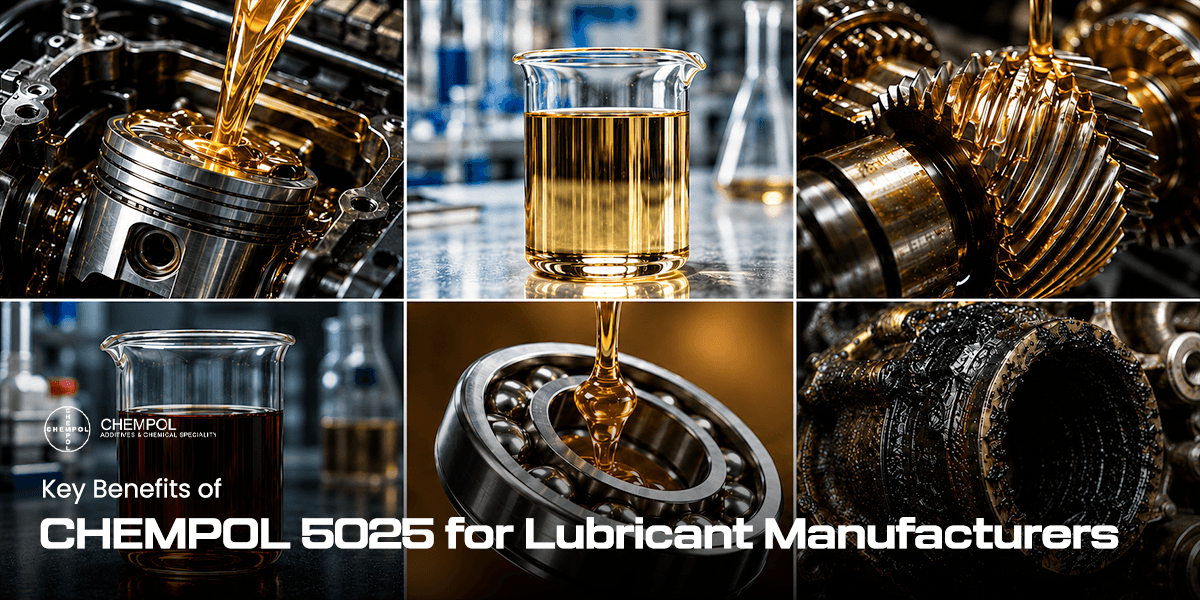
Key Benefits of CHEMPOL 5025 for Lubricant Manufacturers
The two-stroke lubricant’s performance is critically dependent on the formulation’s ability to manage combustion deposits without sacrificing lubrication and engine protection.
Carbon Deposit Control
One of the most significant problems with two-stroke engines is the formation of carbon since the lubricant is used during operation.
CHEMPOL 5025 offers strong detergent activity designed to curb the formation of harmful engine deposits and carbon buildup. Controlling carbon deposition can help keep combustion areas cleaner and minimize the risk of deposits that disrupt normal engine operation.
For lubricant brands, this provides a solid technical basis for creating products positioned at the core of cleanliness and reliable engine operation.
Piston Cleanliness Improvement
Pistons are used in extreme thermal and mechanical environments. These may be deposits formed around the piston crown and ring areas, which may adversely impact engine operation over time.
The chemistry of the detergent present in CHEMPOL 5025 is used to improve piston cleanliness, aiding lubricant manufacturers in developing oils designed to keep key engine surfaces clean.
Cleaner pistons will sustain more consistent engine performance and complement the overall deposit-control strategy of the finished lubricant.
Ring Sticking Prevention
Piston rings should be sufficiently free to maintain their intended sealing and operating capabilities.
Deposits that develop in the ring grooves can contribute to ring sticking, especially under harsh operating conditions or when combustion cleanliness is low.
In its multifunctional performance package, CHEMPOL 5025 is uniquely configured to enhance resistance to ring sticking.
Effective ring-sticking prevention is thus a key aspect of two-stroke engine protection for formulators.
Cleaner Combustion Performance
The composition of the lubricant used in a two-stroke engine directly affects what enters and leaves the engine.
Combined with efficient detergency, low-ash additive technology helps formulators achieve cleaner combustion performance by managing deposit-forming tendencies without compromising the engine protection needed.
This concerns, in particular, lubricant manufacturers designing products for motorcycles, scooters, and utility engines that operate in stop-and-go or variable-load environments.
Smoke Reduction Benefits
The presence of visible exhaust smoke is still a key quality factor for many two-stroke lubricant clients.
The smoke properties of the finished oil depend on the entire formulation, including the choice of base oil, additive chemistry, treatment rate, and operating conditions.
A well-designed low-ash two-stroke engine oil additive is capable of sustaining cleaner combustion and assisting formulators in creating products aimed at improving smoke properties.
CHEMPOL 5025 then offers a suitable technical basis for manufacturers of two-stroke oils, for which the control of deposits, exhaust cleanliness, and smoke reduction in two-stroke engines are significant formulation goals.
Long Lasting Engine Protection
An efficient two-stroke lubricant should not just safeguard the engine under a solitary aspect.
CHEMPOL 5025 is a mixture of detergency and piston seizure protection, as well as ring sticking, engine deposit, and exhaust block protection.
This integrated strategy helps sustain engine performance in the long run, and CHEMPOL 5025 can be used by manufacturers who want an engine protection additive for 2T Oils instead of creating separate performance elements.
Performance Standards Supported by CHEMPOL 5025
The performance specifications serve as a standardized system for measuring the finished oil’s capability by lubricant manufacturers and end users. CHEMPOL 5025 is designed to support formulations for a variety of significant two-stroke performance levels.
API TC
API TC is a performance category for two-stroke engine oils. CHEMPOL suggests CHEMPOL 5025 at 5.0 wt% for formulations targeting API TC performance.
JASO FC
JASO two-stroke classifications place a lot of emphasis on lubrication, detergency, and exhaust-smoke properties. The additive package foundation of CHEMPOL 5025 can be used by manufacturers who are interested in a JASO FC compliant engine additive solution as the basis of the finished formulations that should be developed and validated appropriately.
Global GC
To achieve a Global GC performance in products, CHEMPOL 5025 may be utilized at the recommended 5.0 wt% treat rate.
Global GD
For the upper level of Global GD performance, Chempol recommends a dosage of 7.5 wt%. This renders CHEMPOL 5025 applicable to manufacturers seeking a Global GD performance Additive Package for more challenging two-stroke formulations.
TISI
The requirements of the Thailand Industrial Standards Institute also appear in the list of performance levels that the CHEMPOL 5025 formulation approach supports.
These performance targets are commercially significant for lubricant manufacturers, as they enable them to establish product positioning, formulation strategies, and customer expectations.
Any finished lubricant, however, should have its final claims supported by the manufacturer’s complete formulation, proper testing, and other certification requirements.
Need a Reliable 2T Engine Oil Additive Package?
If you are formulating, upgrading, or commercializing a two-stroke lubricant range, Chempol can support your formulation and sourcing needs. Contact Chempol to discuss:
- Technical consultation.
- Additive package recommendations.
- Formulation guidance.
- CHEMPOL 5025 product samples.
- Recommended treat rates.
- Technical documentation.
- Bulk supply quotations.
Discuss your desired performance level and base-oil system with Chempol’s technical team to establish the best formulation strategy.
Why Low Ash Technology Matters in Two-Stroke Engines
In two-stroke lubrication, in particular, the management of ash is important, since a fraction of the lubricant is burnt during normal engine operation.
An additive system containing too many components that form ash can also cause combustion deposits, piston contamination, and exhaust-system fouling.
A low-ash two-stroke engine oil additive is used to strike a balance between the engine’s protection needs and the need to reduce unwanted deposit formation.
CHEMPOL 5025 is a low-ash additive technology with good detergent performance. The combination helps clean up the pistons, improves the cleanliness of the ring zone, and reduces the occurrence of exhaust-port blocking.
It is especially important to maintain exhaust port cleanliness, as heavy buildup may limit gas flow and impair the engine’s normal operation.
For lubricant manufacturers, low-ash chemistry therefore contributes not only to cleanliness but also to product durability, operating efficiency and the broader objective of dependable two-stroke engine protection.
Base Oil Compatibility and Formulation Flexibility
Commercial lubricant producers rarely work with a single base-oil strategy. Base-stock selection can be affected by availability, price, positioning relative to finished oil, and regional market needs.
CHEMPOL 5025 can be used with a broad selection of base-stock systems, providing formulators with convenient flexibility in developing two-stroke lubricant products. Chempol particularly emphasizes its compatibility with proper mineral base oils and with a wide range of base stocks.
Such flexibility may assist manufacturers in justifying the purchase of raw materials and in creating various product levels based on a shared additive platform.
Mineral base oils may offer an opportunity to mainstream two-stroke products, and companies intending to use semi-synthetic or synthetic formulations should discuss the entire formulation with Chempol’s technical team.
To ensure mineral and synthetic base oil compatibility, final validation shall take into account the base-stock solvency, viscosity, additive response, combustion behaviour and the desired performance claim.
This technical methodology will avoid formulation assumptions and aid in efficient product development.
Industries and Applications That Benefit from CHEMPOL 5025
In most mobility, utility, and equipment markets globally, two-stroke engines remain significant. CHEMPOL 5025 is capable of assisting in the development of lubricants to be used in applications such as:
Motorcycles and Scooters
Two-wheelers used in city traffic need lubricants that can cope with frequent acceleration, variable loads, and high operating temperatures.
Small Utility Engines
Small and portable equipment can be used in strenuous load cycles where deposit control and lubricity are considerations.
Agricultural Equipment
Two-stroke-based agricultural and handheld machines can be used with formulations designed for engine cleanliness and reliable protection.
Recreational Vehicles and Equipment
Certain recreational equipment may also require appropriate two-stroke lubricants, depending on engine design and manufacturers’ requirements.
The formulation priorities in these applications are similar: high-lubricity 2T lubricant additive performance, cleaner combustion, carbon control, piston protection, and reliable operation.

Why Choose Chempol as Your Additive Technology Partner?
The selection of an additive supplier has more than the technical characteristics of a lubricant. It may affect formulation consistency, production planning, technical support, and the rate at which new products are introduced to market.
Chempol serves lubricant producers with highly qualified additive technology designed to meet a range of engine and industrial lubricant requirements.
CHEMPOL 5025 gives manufacturers a known two-stroke additive platform to which they can access documented treat-rate direction and performance positioning across API TC, JASO FC, Global GC, Global GD and TISI criteria. Chempol’s value to B2B customers includes:
- Lubricant additive formulation expertise
- Consistent product specifications
- Technical support for product development
- Additive recommendations based on performance targets
- Industrial supply capabilities
- Support for lubricant blenders and private-label brands
- Documentation and technical product information
- International business support for distributors and manufacturers
For procurement managers, technical teams and formulators, direct contact with an additive technology supplier can also streamline conversations on the dosage, base-stock choice, performance needs and scale-up.
Instead of choosing an additive based on price per kilogram, manufacturers can assess the overall formulation value, including treat rate, desired specification, manufacturing efficiency, and the positioning of the finished lubricant.
Looking for a Trusted Additive Supplier?
Discuss your next 2-stroke lubricant project with Chempol. You can contact the team to:
- Request a CHEMPOL 5025 quotation.
- Request the technical data sheet.
- Request a product sample.
- Discuss formulation requirements.
- Confirm recommended dosage.
- Discuss bulk supply requirements.
- Speak directly with Chempol’s technical team.
You can provide your target performance level, the type of base oil, the positioning of your finished product, and your projected production volume, which will help the Chempol team respond to your inquiry more effectively.
Contact Chempol today to discuss your two-stroke engine oil formulation requirements. Our experts can help you select the right additive technology, optimize performance, and support your business growth with reliable supply and technical expertise.