[email protected]

Pour Point Depressants: A Key Additive for Low-Temperature Oil Performance
Cold temperatures pose major problems for the different types of engines, fuels, and machines. Oil turns thick. Fuel becomes less fluid. Engines barely manage to start. Parts become more abrasive. These problems cost money and shorten the equipment's lifespan. Here is where Pour Point Depressants play a great part. Such additives enhance the performance at very low temperatures by regulating the forming of wax in oils and fuels. They make the fluids capable of movement even in very cold weather. These additives help reduce engine wear and ensure it starts easily even at freezing temperatures.
Today, Pour Point Depressants are essential lubricant components. They play a major part as petroleum, engine oil, and diesel fuel additives across the automotive, industrial, and heavy-duty sectors. In this blog, we will discuss their importance and explain how they enhance low-temperature performance in lubricants.
Understanding Pour Point Additives
The pour point of an oil or fuel is the coldest temperature at which the oil or fuel can still be poured or flowed. Once temperatures drop to below this point, wax crystals start to form inside the fluid. The crystals keep growing, connecting, and eventually clogging the flow. The oil is then said to be stiff and is of no use.
Pour Point Depressants are the agents that prevent this from happening. They change the way wax crystals form. Instead of becoming big and hard, the wax stays small and scattered. The process is called wax crystallization control. It basically allows oil and fuel to be used as liquids even in extremely cold conditions. This is the reason for cold flow improvement and more dependable performance.
Role in Modern Lubricant Systems
All modern lubricant additives rely on pour point depressants. Without them, oils would crash during cold starts and low-temperature operations. When oil gets thick, pumps struggle. Bearings receive less oil, which causes metal parts to come into contact with each other.
Thanks to pour point depressants, the lubricants remain in continuous motion and do not solidify. This way, they ensure they keep performing their duty of protecting the engine without stopping. This way, engines are kept safe from the very first second of startup.
The additives, which are the main source of such protection, become even more vital for vehicles and equipment operating in cold environments, at high altitudes, or in cold storage facilities.
Impact on Engine Oil Performance
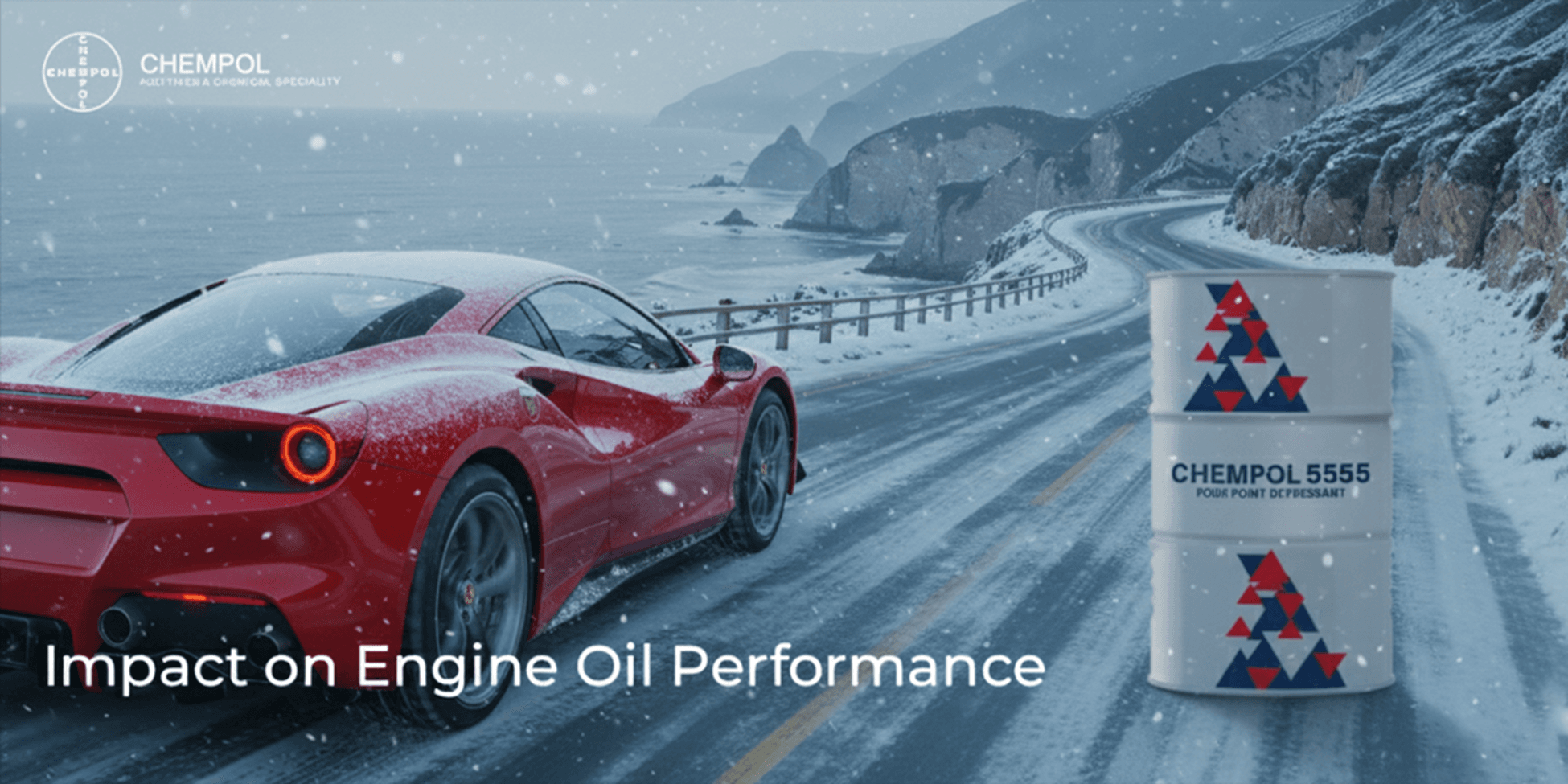
Cold starts are the most damaging and common cause of engine failure at low temperatures. Thick oil moves slowly. It leaves engine parts dry for several seconds. This results in very high friction and prolonged wear. Engine oils with Pour Point Depressants, such as CHEMPOL 5555 one can easily solve this issue. They enable the oil to flow quickly, even at very low temperatures. The lubrication is instant. It lowers the metal contact. It makes the startup smoother. Improved oil flow also lessens the engine load. The engine is working with less resistance. Thus, fuel economy improves, and the engine's lifespan increases.
Pour Point Additives in Diesel Fuel
Diesel is a fuel that contains wax, a natural product. The wax crystallizes when the temperature drops, blocking the fuel lines and filters. The engines become fuel-starved, and the vehicles stop running, and machines come to a standstill.
This is why there are pour-point depressants in diesel additives. They manage wax production and prevent diesel from freezing. It guarantees that the fuel will flow without interruption, even in the cold season. This innovation is very advantageous:
- Reliable cold starts, Clean fuel filters, Stable engine power, Lower risk of breakdown.
- Without these additives, diesel systems suffer major cold-weather failure.
Why Petroleum Additives Depend on Pour Point Technology
Most petroleum additives must work in extreme temperature changes. Oils and fuels face freezing cold in winter and high heat in summer. Pour Point Depressants allow petroleum products to remain stable across this full range.
They protect pumps, injectors, filters, and lines. They keep machines running without interruption. This makes them one of the most critical additives in modern petroleum formulations.
Cold Flow Improvement in Real Operation
Cold-flow improvement should not be considered solely as a laboratory test. It is a change that directly impacts how daily operations are carried out. Devices that start up more quickly consume less battery power. Equipment reaches a safe operating temperature much faster. Oil pressure is getting higher more quickly. This, in turn, enhances the transport, mining, construction, agriculture, and power generation sectors, increasing their output.
Advanced Wax Crystallization Control
The evolution of additive chemistry has enabled significant advances in wax crystallization control. Recently introduced pour-point depressants are compatible with mineral oils, semi-synthetic oils, and full synthetic oils. They extend the service interval without affecting product stability. They do not interact with other additives. This opens the door for lubricant producers to manufacture top-performing, high-grade oils that are highly effective even in harsh climates.
Economic and Environmental Benefits
Implementing better low-temperature operation strategies reduces fuel waste. Engines reach working temperature much more quickly. The process of fuel combustion becomes more efficient. As a result, pollutant levels and carbon output decrease. Also, prolonging oil life reduces maintenance expenses and waste oil disposal costs.
Applications Across Industries
Pour Point Depressants support many sectors:
- Automotive engines
- Heavy-duty trucks
- Construction equipment
- Marine engines
- Industrial hydraulics
- Mining machinery
- Power plants
Any system exposed to cold conditions depends on them.
Future of Low-Temperature Additive Technology
Low temperature performance is one of the most challenging problems in the modern fuel industry. Fuel standards are becoming stricter, and engines are getting more sophisticated; thus, the need for improved low-temperature performance additives is constantly growing. Today, additive chemistry focuses on more efficient wax control, better fuel compatibility, and longer-lasting protection. However, Pour Point Depressants remain the main factor in this transition.

Chempol: The Most Reliable Source of Additive Innovation
Chempol provides innovative Pour Point Depressants and a broad range of high-performance additives to worldwide markets. Chempol's premium lubricant additives, petroleum additives, engine oil additives, and diesel additives are the best solutions for improving cold-flow in fuel additives, controlling wax crystallization, and providing stable low-temperature performance. With Chempol, engines are clean, energy-efficient, and dependable in any climate. So contact them now and learn more about their additives.