[email protected]

The Essential Guide to Anti-Foam Additives for Hydraulic Oils
In industrial operations, ensuring smooth machinery performance is key to enhancing productivity and reducing maintenance costs. One common problem that can disrupt this process is foam formation in lubricants. Foam can significantly degrade lubricant performance, causing wear and tear on equipment and reducing lubrication efficiency. All this can lead to overheating, which is unacceptable for better productivity. This is where anti-foam additives for lubricants come in. These additives are specifically designed to prevent or eliminate foam from forming in lubricants. They ensure you get optimal performance.
In this blog, we’ll discuss the importance of anti-foam additives for hydraulic oil, how they function, and their specific application in hydraulic systems. Moreover, we’ll also touch on key considerations when choosing the right anti-foam additive for hydraulic oil and why anti-foam additives in lubricant formulation are a significant part of creating high-performance lubricants.
What is an Anti-Foam Additive?
An anti-foam additive for lubricants is a chemical substance that is added to lubricants and oils to eliminate or reduce foam. Foam in lubricants can cause several issues, including air bubbles that prevent proper lubrication, which causes friction between components. This can result in reduced efficiency and equipment failure. By introducing anti-foam additives for oils, manufacturers can ensure that their lubricants work effectively, even under extreme operating conditions.
How Do Anti-Foam Additives for Oils Work?
anti-foam additives work by breaking down the foam that develops in the lubricant. These additives lower the surface tension of the foam and consequently result in the collapse of foam bubbles. The anti-foam additive for hydraulic oil also acts in a similar manner, solving the particular problems in hydraulic systems where the foam may lead to further problems because of the high pressure and fluid flow. Foam can form a layer in certain systems, and the oil cannot circulate as it should, and hence, lubrication will not occur well.
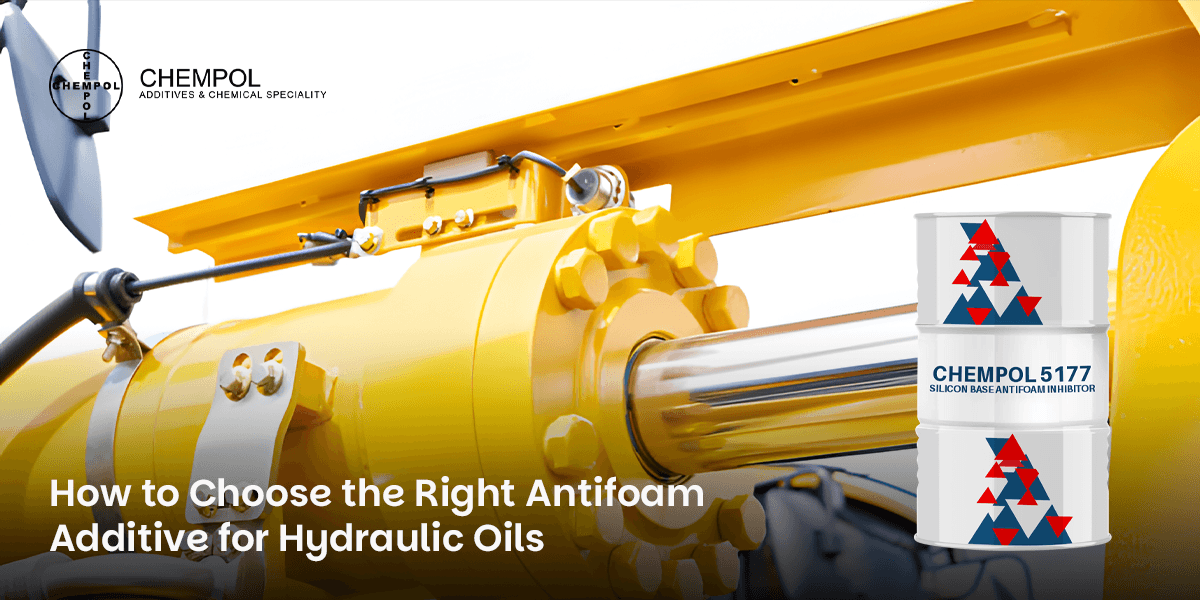
Anti-Foam additives in the formulation of lubricant prevent the formation of foam, thus ensuring that the lubricant remains intact and the machinery can operate at its best. Generally, these additives are created using oils, silicones, or organic compounds that can easily destabilize and break up foam bubbles. You can also try Chempol 5177 Silicon-Based Anti-Foam.
Types of Anti-Foam Additives: Silicon-Based vs. Non-Silicon-Based
Anti-Foam additives are significant in industrial applications to prevent or to decrease the formation of foam in the lubricants, oils, and other fluids used in processing. These additives can be divided into two major groups, viz. Silicon-Based anti-Foam Additives and Non-Silicon-Based anti-Foam Additives. These two types have their unique features, making them suitable for various applications.
Silicon-Based Anti-Foam Additives
Silicon-based anti-foam additives are one of the most widely used solutions for the control of foam in different industrial environments. Such additives are mainly composed of silicone compounds and have been known to be very effective in managing foam in challenging environments.
Features of Silicon-Based Anti-Foam Additives
A major advantage associated with silicon-based anti-foam additives is that they work well in high temperature conditions. They do not change even at extreme temperatures and are therefore suitable in systems that have a high temperature, e.g., engines or high-speed machinery. Moreover, these additives are also used in long-term foam control; therefore, the lubricant or oil does not need replacement even in intense operational conditions.
Moreover, the silicon-based additives provide shear stability, meaning they are able to maintain mechanical stress without losing their effectiveness. This is the most valuable property in applications where the pressure system is high, and where the hydraulic oil is constantly under stress, used in the heavy-machinery.
Another advantage of silicon-based anti-foam additives is their broad compatibility with a wide range of fluids and applications. They are common in the automotive industry, hydraulic industry, and even when it comes to the food industry, where foam control is necessary.

Applications of Silicon-Based Anti-Foam Additives
Silicon-based anti-foam additives are likely to be used in high-speed systems and in high-temperature applications due to their stability at high temperatures and performance in extreme conditions. Hydraulic oils also contain these additives, where their ability to maintain consistent foam control under pressure is important for the proper functioning of hydraulic systems. Food-grade oils also use these additives as they offer effective and safe control of foams to the end product and are safe to consume.
Non-Silicon-Based Anti-Foam Additives
Another type of foam-control additive is non-silicon-based, which is made of organic compounds, polymeric substances, or mineral oils. These additives are a perfect choice to silicon-based additives when they are not suitable or not required in particular applications.
Features of Non-Silicon-Based Anti-Foam Additives
The cost-effectiveness of non-silicon-based additives is one of their major advantages. These additives are usually more economical than silicon-based anti-foam additives, making them appropriate to use in those applications that value the cost factor. Also, additives based on non-silicon are usually more eco-friendly. They are generally made of biodegradable materials, making them attractive to industries that are concerned with sustainability and reducing environmental impact.
Although these additives do not match silicon-based additives in terms of long-term performance or high-temperature stability, they can be used effectively as foam stabilizers where less extreme conditions are present. In addition, non-silicon-based additives have been applied in case the foam control agent has to be viewed in the end product. An example is when using non-silicon additives in the pharmaceutical or cosmetics sector, since they have fewer residual effects.
Applications of Non-Silicon-Based Anti-Foam Additives
The non-silicon-based additives are highly utilized in applications like water-based fluids, such as coolants, paints, and coatings. These additives help prevent foam with no effect on the outlook or performance of the final product. Moreover, they are widely used in such industries as pulp and paper, where organic-based additives are more welcomed due to their biodegradability.
Non-silicon-based anti-foam additives can also be used in other applications, such as cosmetics and pharmaceutical formulations, where a more environmentally friendly and less visible foam control solution is required.
Comparing Silicon-Based and Non-Silicon-Based Anti-Foam Additives
In the comparison of silicon-based anti-foam additives with non-silicon-based additives, a number of factors arise, which are temperature stability, shear stability, environmental impact, and cost-effectiveness.
Silicon-based additives are good in high temperature and high-pressure types of environments. They are designed to be stable and efficient in extreme conditions, making them the most preferable option for high-speed systems and systems that operate at high temperatures. They also have a long lifespan and are very shear-stable and are hence used in situations where heavy machinery and hydraulic systems are involved. They are more costly than their non-silicon-based counterparts, and may leave residues in some applications.
Conversely, non-silicon-based additives are cheaper and eco-friendly. They can be used in applications that do not provide such high sensitivity in the context of extreme temperature and pressure stability. These additives are normally applied in fluids based on water and sustainability-based industries. Although they do not provide the same long-term performance or high temperature stability as silicon-based Anti-Foam additives. They offer good foam control and are a cheaper choice in some applications.
Importance of Anti-Foam Additives for Hydraulic Oil
Foam formation is very prone in hydraulic systems, e.g., those used in heavy machinery, construction equipment, and presses used in industries. Anti-Foam additives for hydraulic oils are important in ensuring the smooth running of these systems. Energy in machinery is transferred using hydraulic oils, and the formation of foam may interfere with this transfer, resulting in loss of power and efficiency. Air bubbles can also be produced by foam, and this can interfere with the functioning of hydraulic valves and cylinders.
The inclusion of anti-foam additives for hydraulic oil enhances the pressure performance of the oil, reduces the chances of foam formation, and maintains the uniform flow of the fluid. These additives increase the performance of hydraulic systems and the life of the equipment.
Why Use Anti-Foam Additives in Lubricant Formulation?
The use of anti-foam additives in the formulation of lubricants is important to maintain the long-term performance of lubricants. During most industrial processes, lubricants are required to work under challenging conditions, such as high temperatures, high speeds, and heavy loads of the machinery.
Anti-Foam additives for oils are an integral part of such formulations as they assist the lubricants to maintain their properties even in the presence of stress conditions. In the absence of such additives, the formation of foam would considerably reduce the ability of the lubricant to protect components and lead to increased wear, overheating, and maintenance expenses.
By adding anti-foam additives to the lubricant formulation, which are used to stabilize the oils, decrease the equipment downtimes, and lower the overall maintenance expenses.
Benefits of Anti-Foam Additives in Lubricants
Utilization of anti-foam additives for lubricants in a well-formulated lubricant will have many advantages, such as:
Improved Lubrication Efficiency
The lubricant will be able to perform more efficiently by avoiding the formation of the foam that will reduce friction and wear.
Increased Equipment Lifespan
Foamy lubricants may result in excessive wear of parts. Anti-Foam additives prolong the life of equipment because they remove the foam.
Reduced Maintenance Costs
The absence of foam makes the work of the equipment smoother, and its frequent breakdowns are minimized.
Enhanced Stability Under Extreme Conditions
In high-speed or high-temperature applications, anti-foam additives can be used to ensure that lubricants can be used, even in extreme conditions.
Better Energy Efficiency
An anti-foaming lubricant minimizes friction within the machine and can ensure better energy consumption of the machine.
How to Choose the Right Anti-Foam Additive for Hydraulic Oils
When choosing the right anti-foam additive for oils, one should take into consideration the specific operating conditions of the machines. Key factors include:
Operating Temperature
In case your system is working at high temperatures, then you will require a high-temperature anti-foam additive that will work well at high concentrations.
System Pressure and Speed
An Anti-Foam additive for high-speed systems or a shear-stable anti-foam additive would be necessary in high-speed systems or those under high pressure.
Type of Equipment
Different machines and systems might need particular types of additives to prevent foam, e.g., anti-foam additives for hydraulic oil for hydraulic systems.
Knowing these factors, you will be able to choose an anti-foam additive in lubricant formulation that best meets the requirements of your equipment and operations.
Why Choose Chempol for Anti-Foam Additives
The need to add anti-foam additives to your lubricant formulations can be considered as part of preventing the issue of foam that may lead to wear, excessive heat, and other inefficiencies of industrial machinery. Whether you are dealing with high-speed machines, high temperatures, or hydraulic equipment, there is an Anti-Foam additive for oils that can make your oils perform better and give your equipment a longer life.
When you are in need of high-quality anti-foam additives, Chempol is the place to be found. Our additive portfolio is geared towards satisfying the requirements of different types of industrial applications and guarantee that your lubricants give a high level of performance and reliability. For more information or to get the best anti-foam additives for lubricants, contact Chempol today!